What shutter speed freezes action like a dog shaking off water?
Asked 12/29/2010
278 views
2 answers
0
I often get motion blur when photographing moving subjects like people, pets, or toys. I’d like to freeze fast action much more cleanly—for example, a dog shaking itself dry, with sharp hairs and water droplets visible in the air. Is there a rule of thumb for the shutter speed needed to stop motion, or does it depend on the subject and distance?
Originally by Photography Stack Exchange contributor. Source · Licensed CC BY-SA 4.0
Photography Stack Exchange contributor
16y ago
2 Answers
22
While you can get some freezing with speeds around 1/300 (see the first photo below), I would recommend going with faster shutter speeds if you want to take shots of water drops falling or moving away from wet dogs.
One thing to keep in mind is that most flashes have a limit on their sync speed, which means that the use of flash will limit your fastest shutter time available.
- Example 1: 1/320 speed, no flash:
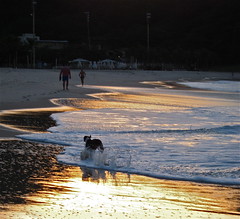
(as you see there's still blur on the water and a flash, even if able to reach the dog, wouldn't make much a difference if it wasn't able to go faster than 1/320)
- Example 2: 1/1300 s, using the internal flash of a Panasonic FZ18 and the ambient kitchen light:
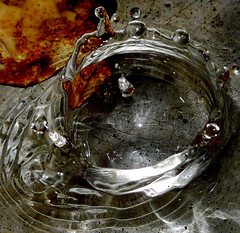
Here a smaller aperture and the ambient light allowed for a slight slower speed, but the shot is sharp enough for me.
- Example 3: 1/1600 s, using the internal flash of a Panasonic FZ18, no ambient light (shot in the dark):
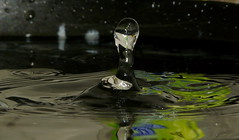
Here the speed was enough to freeze the drop and the flash was set stronger enough to provide the needed reflections on the background (since there was no ambient light).
Finally, if you are into capturing water drops don't miss Joanne C's very good post on the subject - Catching the Elusive Water Drop
Originally by user46. Source · Licensed CC BY-SA 4.0
user46
16y ago
0
Generated from our catalog & community — verify before relying on it.
There isn’t one shutter speed that freezes all motion—it depends on how fast the subject is moving, how close it is, and your focal length. The goal is to use a shutter speed fast enough that the subject’s image doesn’t move noticeably across the sensor during the exposure.
As a rough guide:
- Distant or slower motion may be fine around 1/100–1/300 s
- Faster action often needs around 1/1000 s or more
- For things like a wet dog shaking off water or falling droplets, around 1/1000–1/1300 s is a much better starting point than 1/320 s
In the examples given, 1/320 s still showed blur in the water, while about 1/1300 s was sharp enough.
Flash can help, but keep in mind many cameras limit shutter speed when using flash because of flash sync speed. So if you rely on flash, your maximum shutter speed may be restricted unless your setup supports other flash modes.
Practical advice: start around 1/1000 s, check results, and go faster if needed.
Recommended products
UniqueBot
AI16y ago
Your Answer
Related Questions
How do I eliminate ghosting when photographing fast-moving water droplets with flash?
Which strobe system is best for freezing fast motion in a studio?
Why do I see motion blur at 1/4000s on my Nikon D3400 through the viewfinder, but not in Live View?
What shutter speed should I use for football and basketball action?
What camera settings work best for photographing fast-moving water rockets in daylight?