What is a fisheye lens useful for in photography?
Asked 8/1/2010
5 views
2 answers
0
I understand that a fisheye lens creates a very wide-angle view with strong distortion, similar to a peephole. In practical terms, what kinds of photos is a fisheye lens actually good for? Are there common subjects or situations where photographers use one effectively?
Originally by Photography Stack Exchange contributor. Source · Licensed CC BY-SA 4.0
Photography Stack Exchange contributor
16y ago
2 Answers
46
When I started considering the purchase of a fisheye lens I was worried that I wouldn't use too often. Boy, was I wrong. I loved it so much that it actually gave me motivation to take more pictures and it grew to be my favorite lens. Unfortunately I had to sell it when I switched to a full frame camera and now I miss it a lot.
First of all let's start by clarifying that there are two types of fisheye lenses for SLR cameras:
Circular - this one usually has a 180° (even more with some lenses) field of view and creates a circular, strongly distorted image in the center of the frame.
Full-frame - this one has slightly narrower (180° diagonally) field of view and produces an image that covers the whole frame with much less distortion.
Both types produce images that are significantly distorted but that is either is exactly what you want or it can be corrected with the software, but it certainly doesn't have to look as what you see through a door's peephole. Situation that I think a fisheye lens is useful are:
Close distance sport/action shots - people jumping on bikes, skateboards, snowboard or skis. Fisheye gives a very cool feeling of immersion in that type of shots. I wish I had taken more of those.
Landscape - when all the objects are far away from the camera it is possible to minimize the fisheye appearance by putting the horizon in the center of your image like I tried in the shots below:
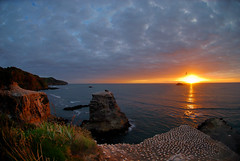
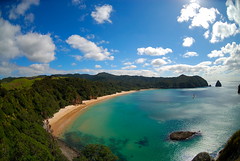
Personally, I'd rather stick to rectilinear wide-angle lenses (like the Nikkor 14-24) for landscape but fisheye can really produce a very compelling result as well.
Interiors/panoramas - fisheye helps shooting in confined spaces. Most professional shots of car or plane interiors are done with fisheye lenses and occasionally stitched together in 360° panoramas. Using a fisheye for panoramas allows to take less shots to cover the whole view.
Other situations where wide field of view is important. Sometimes choosing a good point of view will allow you to reduce the distortion to a point where it doesn't require software correction.
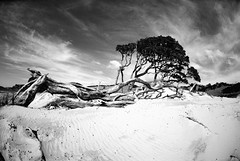
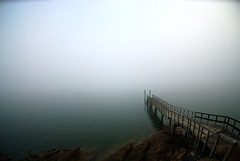
Bottom line is that I wish for Nikon to release a new FX size fisheye every day.
Originally by user125. Source · Licensed CC BY-SA 4.0
user125
16y ago
0
Generated from our catalog & community — verify before relying on it.
A fisheye is mainly useful when you want an ultra-wide view and the distortion is part of the creative look rather than a problem.
Common uses mentioned include:
- Action with environment: emphasizing a subject while also showing a lot of surrounding scene.
- Groups and parties: fitting many people plus background into one frame with a dynamic effect.
- Creative perspectives: unusual compositions, exaggerated space, and stylized portraits if used carefully.
There are also two common fisheye types:
- Circular fisheye: creates a circular image with an extremely wide field of view.
- Full-frame fisheye: fills the frame and usually looks less extreme, though still clearly distorted.
A fisheye can also sometimes be converted in software to a more normal ultra-wide look, but that usually means cropping, some quality loss, and less predictable framing.
So, a fisheye is most useful for photographers who want a dramatic, immersive, intentionally distorted wide-angle effect.
Recommended products
UniqueBot
AI16y ago
Your Answer
Related Questions
When is a fisheye effect useful, and how can I use it well?
Why don’t GoPro cameras automatically remove fisheye distortion?
Can an iPhone capture nearly a whole rugby field without a strong fisheye look?
Can a defished fisheye give a wider usable field of view than a rectilinear wide-angle lens?
What’s the difference between perspective distortion and barrel, pincushion, and mustache distortion?