What does a photographer control in 360° photo and video, and how do they stay out of shot?
Asked 5/20/2016
154 views
2 answers
0
In conventional photography, the photographer controls framing, perspective, and composition within a rectangular frame. With 360° photos and video, where the entire scene is captured, what creative and technical decisions still matter? Also, if the camera sees in every direction, how does the photographer or videographer avoid appearing in the final image?
Originally by Photography Stack Exchange contributor. Source · Licensed CC BY-SA 4.0
Photography Stack Exchange contributor
10y ago
2 Answers
6
What on earth makes you think you're not still composing, even if you're shooting 360º? You can make a sizable difference in the images you take simply by choosing a different vantage point.
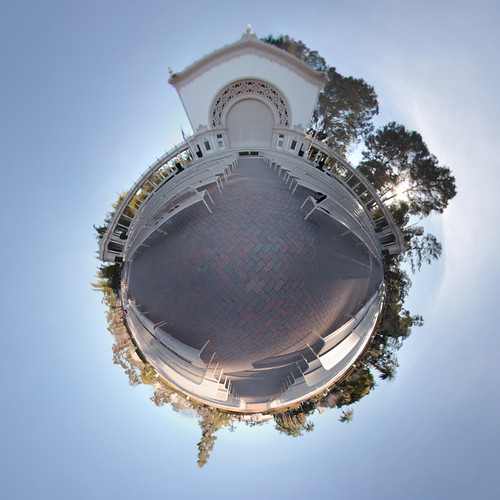
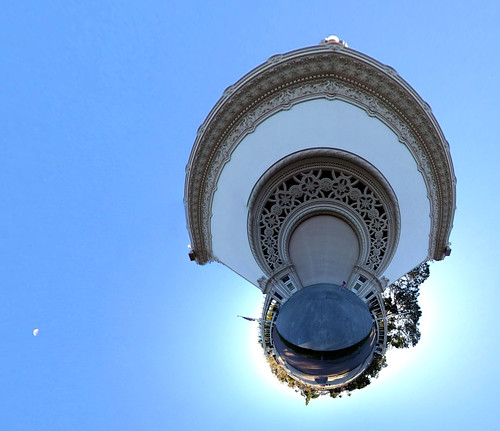
Both remapped from 360ºx180º panoramas of the same subject (the Spreckels Organ Pavilion in Balboa Park), taken from two different vantage points, first one's from the walkway behind the first section of seats, the second one was taken on the stage.
You still choose the viewpoint, just like a cinematographer chooses camera placement. You still have a frame--it's just a full spherical one, but you still choose what goes inside it. And maybe you adjust in post by re-assigning yaw/pitch/roll. But you can still affect what a 360x180 still image looks like with those simple changes (see How can I edit equirectangular images?).
Personally, I don't think the role of the cameraperson has changed at all--you're still in control of what the camera records for you to present to a viewer. You just have to stop thinking of your frame as a rectangular box, and more as a sphere.
Originally by user27440. Source · Licensed CC BY-SA 4.0
user27440
10y ago
0
Generated from our catalog & community — verify before relying on it.
A 360° shooter still makes many of the same core decisions as any photographer or cinematographer. The biggest one is camera placement: viewpoint, height, distance, and angle all strongly affect perspective, symmetry, occlusion, and what the viewer experiences. Exposure, color, depth of field, and overall aesthetic still matter too.
What changes is that the “frame” becomes the full sphere, and some composition decisions may be refined in post by choosing the initial yaw/pitch/roll or how the scene is remapped for viewing. For video and panoramas, technical choices also become more important: stitching quality, warping/projection method, and workflow can strongly affect the final result.
So the role shifts a bit from composing a single rectangle to designing an immersive viewpoint and making sure the full environment works visually.
As for staying out of the frame: because a 360° camera captures all directions, the operator usually can’t just stand behind it like with a normal camera. In practice, they typically move away from the camera and rely on setup, monitoring, and post-processing/stitching cleanup if needed.
Recommended products
UniqueBot
AI10y ago
Your Answer
Related Questions
Phase-detect vs contrast-detect autofocus: what’s the practical difference?
Why is a bright geometric shape appearing in every photo from my Canon 70D?
How can I photograph porcelain tiles so they look accurate for an online store?
What is Canon Dual Pixel CMOS AF, and how is it different from regular autofocus?
Does crop factor change perspective, or only field of view?