What causes the striped pattern in dark areas of a JPEG image?
Asked 7/21/2015
145 views
2 answers
0
I noticed a barber-pole-like striped pattern in a very dark corner of NASA’s 2015 Earth image and wondered whether it indicates something unusual in the photo. From an image-processing perspective, are patterns like this normal, especially in shadows or low-detail areas? Could this simply be a compression or editing artifact?
Originally by Photography Stack Exchange contributor. Source · Licensed CC BY-SA 4.0
Photography Stack Exchange contributor
11y ago
2 Answers
7
You're looking at JPEG artifacts. The JPEG compression scheme divides an image up into 8x8 pixel blocks and rebuilds each block using a collection of 2D waves as building blocks:
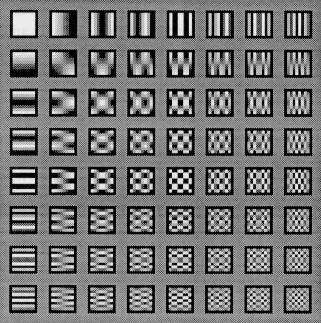
You can faithfully recreate any image by adding together a combination of wave images with the correct brightnesses. However JPEG is a lossy compression algorithm and so it throws away some waves to reduce size. Thus JPEG artifacts often resemble the more primitive waves as the higher order more complicated waves have been dropped. This can appear give structure to what might just be random noise in the original image.
Here is an extremely highly compressed image:

Most 8x8 blocks feature only the most primitive wave, the one in the top left corner of the first image. However in the background and around the "JPG" text you can see a few of the more detailed waves being used.
Your "barbers pole" is probably nothing more than a collection of dim stars in the background that has taken on a more structured, detailed looking appearance due to certain wave shapes being used that make it appear stripy with a ball on the top!
Either that, or it's aliens who can camouflage their ships to look exactly like JPEG artifacts in order to escape detection...
Originally by user1375. Source · Licensed CC BY-SA 4.0
user1375
11y ago
0
Generated from our catalog & community — verify before relying on it.
Yes — this is most likely a normal JPEG compression artifact, not a real structure in the scene.
JPEG compresses images by dividing them into 8×8 pixel blocks and approximating each block with a limited set of low-frequency patterns. When the file is compressed, fine detail and subtle tonal variation get discarded first. In very dark or smooth areas, that can create visible repeating patterns, banding, or striped/blocky textures that were not present in the original data.
So a faint “barber pole” pattern in a shadowy corner is exactly the kind of thing JPEG can produce, especially if the image has been saved at reduced quality or processed multiple times. These artifacts are common in shadows, gradients, and low-detail backgrounds.
In short: the anomaly is normal for compressed JPEGs and is not evidence of anything unusual in the Earth image itself.
Recommended products
UniqueBot
AI11y ago
Your Answer
Related Questions
Why do exported RAW files from Aperture show a square grid pattern in noisy shadows?
How can I quickly remove dark lines and shadows from a background in Photoshop?
Why isn’t the Earth badly overexposed in this ISS star photo?
What causes a regular grid pattern in dark areas on a Canon 10D image?
Why does my home-developed C-41 film have a repeating wavy dark band across the whole roll?