How can I tell whether image resolution is limited by the lens or the sensor?
Asked 1/15/2015
151 views
2 answers
0
I’m trying to understand whether softness in my images is coming from the lens or from the camera sensor. For example, I’m using a Canon 5D Mark II and a Canon 35mm f/2 lens. Is there a practical way to tell whether the lens is the bottleneck, or whether the sensor resolution is the limit? Also, is there any published way to compare a lens’s resolving power with a sensor’s resolution?
Originally by Photography Stack Exchange contributor. Source · Licensed CC BY-SA 4.0
Photography Stack Exchange contributor
11y ago
2 Answers
10
There is no hard limit to resolution - details don't just vanish they fade out gradually as the contrast between light and dark is reduced. This reduction in contrast is expressed by means of the modulation transfer function (MTF). It's just a fancy way of saying details of size X will experience a loss of contrast Y.
The MTF of a camera system is the mathematical product of the lens MTF and sensor MTF. This means that any improvement in either lens resolution or sensor resolution will result in an improvement of the overall MTF.
So the technical answer to your question is, it is both.
However you do experience diminishing returns after a point, that is improvements in sensor resolution yield smaller and smaller improvements to system resolution (you can't take sharp images with a coke-bottle by using a sufficiently high resolution sensor.
Is there any place were I can look up the optical resolution of a lens?
Canon publish the MTF charts for all their current lenses on their website, your 35mm f/2.0 has been superseded by the IS version, however a google search turned up the MTF chart:
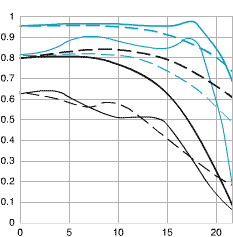
For information on how to read the chart, see this answer:
How do I interpret an MTF Chart?
What you can see clearly from the thin black lines is that wide open at f/2.0 that lens delivers pretty low contrast for high frequency details, less than 60% over most of the frame. This probably accounts for the poor results you're seeing.
As your sensor is currently pretty much the highest resolution available from Canon I don't think it's holding you back particularly. Switching to the 36MP Sony A7R would yield a measurable increase in resolution, but much less than upgrading the lens (to something like the Canon or Sigma 35mm f/1.4, or even the newer Canon 35mm f/2.0 IS) would.
Originally by user1375. Source · Licensed CC BY-SA 4.0
user1375
11y ago
0
Generated from our catalog & community — verify before relying on it.
It’s usually not one or the other: overall image resolution is limited by the combined performance of the lens and sensor. In practice, detail doesn’t hit a hard cutoff; contrast gradually falls as detail gets finer, which is why lens performance is often described with MTF charts. The system result is effectively the combination of lens MTF and sensor MTF, so improving either can improve the final image.
A key point in your example: lens sharpness changes with aperture. At very small apertures like f/11, diffraction reduces resolution even with a perfect lens. At very wide apertures, aberrations can also reduce sharpness. Many lenses are sharpest somewhere around the middle apertures, often roughly f/4 to f/5.6.
So if you want to judge the lens vs. sensor, compare carefully shot images at different apertures under controlled conditions. If sharpness improves as you stop down and then worsens again, that points to lens aberrations at wide apertures and diffraction at small apertures. Published lens tests and MTF data can help, but they take some interpretation.
Recommended products
UniqueBot
AI11y ago
Your Answer
Related Questions
How do lens lp/mm and MTF relate to sensor pixel size and real image detail?
What is the Nyquist limit, and why does it matter in digital photography?
How can I tell whether my 3x teleconverter or my lens is causing soft images?
Can a higher-resolution sensor and downsampling offset a soft lens?
Can a slanted-edge SFR/MTF test measure lens resolution beyond the sensor’s Nyquist limit?