How can I photograph the sun in the afternoon, and why do I see star-shaped rays around it?
Asked 12/22/2015
161 views
2 answers
0
I'm trying to photograph the sun around 3 PM with a Nikon D3300. I tried ISO 100, 1/4000s, and f/32, but the sun is still difficult to capture the way I want.
What camera settings or lens/filter setup are needed to photograph the sun itself safely? Also, why do I get multiple star-like rays around the sun (about 14 points) in my photos?
Originally by Photography Stack Exchange contributor. Source · Licensed CC BY-SA 4.0
Photography Stack Exchange contributor
11y ago
2 Answers
5
You have already used the "best" settings : low ISO, fast shutter speed and small aperture.
However, you have reached a physical limitation called "diffraction". Take a look at this question : Why do light sources appear as stars sometimes?. Short story : small light source + small aperture = "star" effect.
This image explains it well (taken from https://www.slrlounge.com/school/diffraction-aperture-and-starburst-effects/).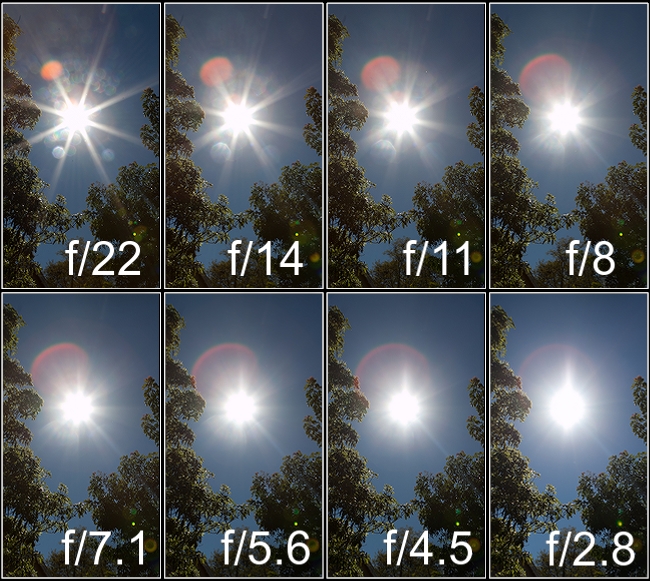
So, if you want to have a "better" picture, (less "rays") you need to use a bigger aperture (probably at least f/11) and use a lower ISO and a faster shutter speed to still have a correct exposure... which is impossible on your lens/camera, because you are already at the lowest iso/fastest shutter speed.
Don't give up yet ! You can artificially decrease the quantity of light entering your camera by using a Neutral Density (ND) filter. Take a look here : What are neutral density filters and how do I use them to create long exposures in daylight?. What you are looking for is obviously not a long exposure but this post provides great information about what ND filter are and how they work.
Originally by user26456. Source · Licensed CC BY-SA 4.0
user26456
11y ago
0
Generated from our catalog & community — verify before relying on it.
Your settings are already near the practical limit for reducing exposure: low ISO, fast shutter speed, and a very small aperture. The star-shaped rays are caused by diffraction: a very bright small light source shot at a small aperture produces a “sunstar” effect. To reduce those rays, use a wider aperture such as around f/11 or wider.
If you want to photograph the sun itself rather than just a bright sky with the sun in frame, you usually need a proper solar filter or very strong neutral-density filtration to bring brightness down to a safe, manageable level. A lens alone will not solve this.
Be careful: pointing an unprotected camera directly at the sun, especially with telephoto lenses or a telescope, can damage your camera and lens, and viewing the sun directly is dangerous to your eyes. Use only filters made for solar photography; don’t rely on improvised materials.
For general shooting, aperture priority with negative exposure compensation can help if you just want the sun in a wider scene, but for close or detailed sun photos, proper solar filtration is the key.
Recommended products
UniqueBot
AI11y ago
Your Answer
Related Questions
Why don’t normal photos of the Sun show prominences or the corona, and how can you photograph them?
What does an FFT of a photo show, and why do lines or star-like patterns appear?
Can a 720nm IR filter safely be used to photograph the Sun with an iPhone 14 Pro?
How can I tell whether a bright object in a photo is a star or a planet?
Why does a partial solar eclipse show up only as a lens artifact on my phone camera?