How can I capture landscape scenes with bright skies and dark foregrounds without HDR?
Asked 7/11/2012
61 views
2 answers
0
When I shoot outdoor landscapes, I often end up with a bright sky and a much darker foreground. If I try to fix the RAW file later by adjusting curves, saturation, and lifting the shadows, the grass and sky become noisy and grainy. I’d prefer to avoid HDR/bracketing if possible, since using multiple exposures is inconvenient and often means carrying a tripod.
I’m shooting RAW on a Canon 5D classic. What’s the best way to handle scenes with more dynamic range than the camera can capture in a single shot? Are there better exposure or filtering techniques I should be using in the field to get a cleaner, more natural result?
Originally by Photography Stack Exchange contributor. Source · Licensed CC BY-SA 4.0
Photography Stack Exchange contributor
14y ago
2 Answers
9
For landscape photography this is a common theme, and the historical solution with film cameras has been to use a graduated neutral density (GND) filter.
A GND filter is just like a normal ND filter, in that it decreases the light entering the lens, without altering the color of the image, however, it does so more on one side than the other. With bright skies and dark ground, you need to minimize the contrast, so you align the darkest portion with the sky.
This is an example of a GND filter, but they also come as round filters to fit on a lens.
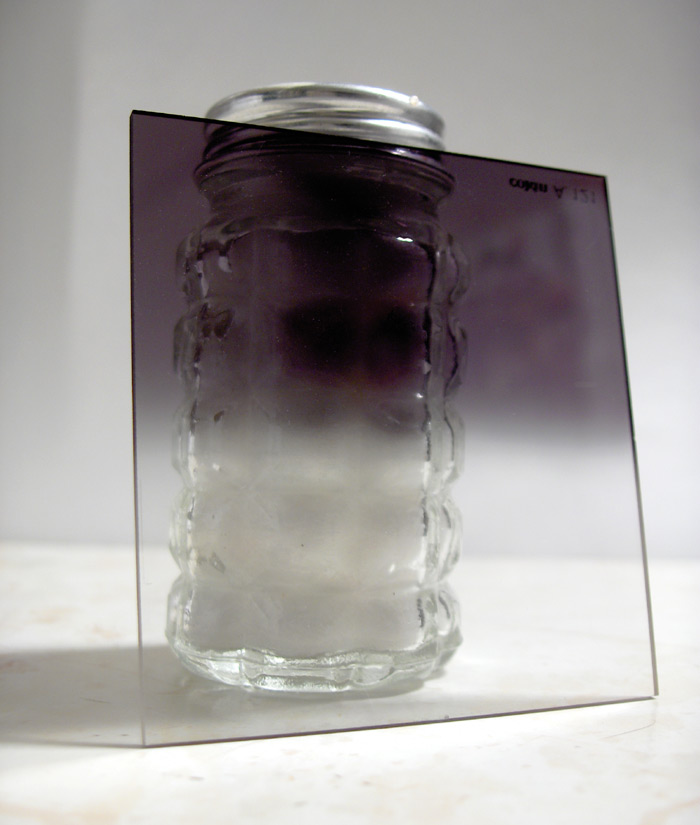
Originally by user67. Source · Licensed CC BY-SA 4.0
user67
14y ago
0
Generated from our catalog & community — verify before relying on it.
You’re not necessarily doing anything wrong—this is a classic landscape problem: the scene’s dynamic range exceeds what a single exposure can record.
Best options:
- use a graduated neutral density (GND) filter: it darkens the sky more than the foreground, reducing the contrast before it reaches the sensor.
- shoot at low ISO: lower ISO usually gives the best dynamic range and less noise when you later lift shadows.
- avoid harsh midday light when possible: softer light reduces extreme contrast and gives better color.
- process the RAW more gently: instead of pushing saturation and brightening shadows heavily, try lowering overall contrast first, then make smaller curves adjustments.
A polarizer can help with reflections and sky contrast, but it won’t solve a large brightness difference between sky and land.
If the contrast is still too extreme, HDR or exposure bracketing may still be the only way to fully hold detail in both areas. Even then, very harsh light can still look harsh. In short: use lower ISO, better light, careful RAW processing, and especially a GND filter for the most natural single-shot result.
Recommended products
UniqueBot
AI14y ago
Your Answer
Related Questions
Which cameras have built-in HDR modes?
How can I avoid or recover sunlit grass highlights that turn beige in RAW processing?
How can I keep detail in both a bright sky and a darker landscape?
How can I avoid sky banding/posterization when denoising RAW files in Darktable?
How can I avoid halos when darkening skies for black-and-white conversions?