Compare in-stock Zoom microphones for camera audio, lavalier recording, computer podcasts and Lightning devices, with prices and buying advice.
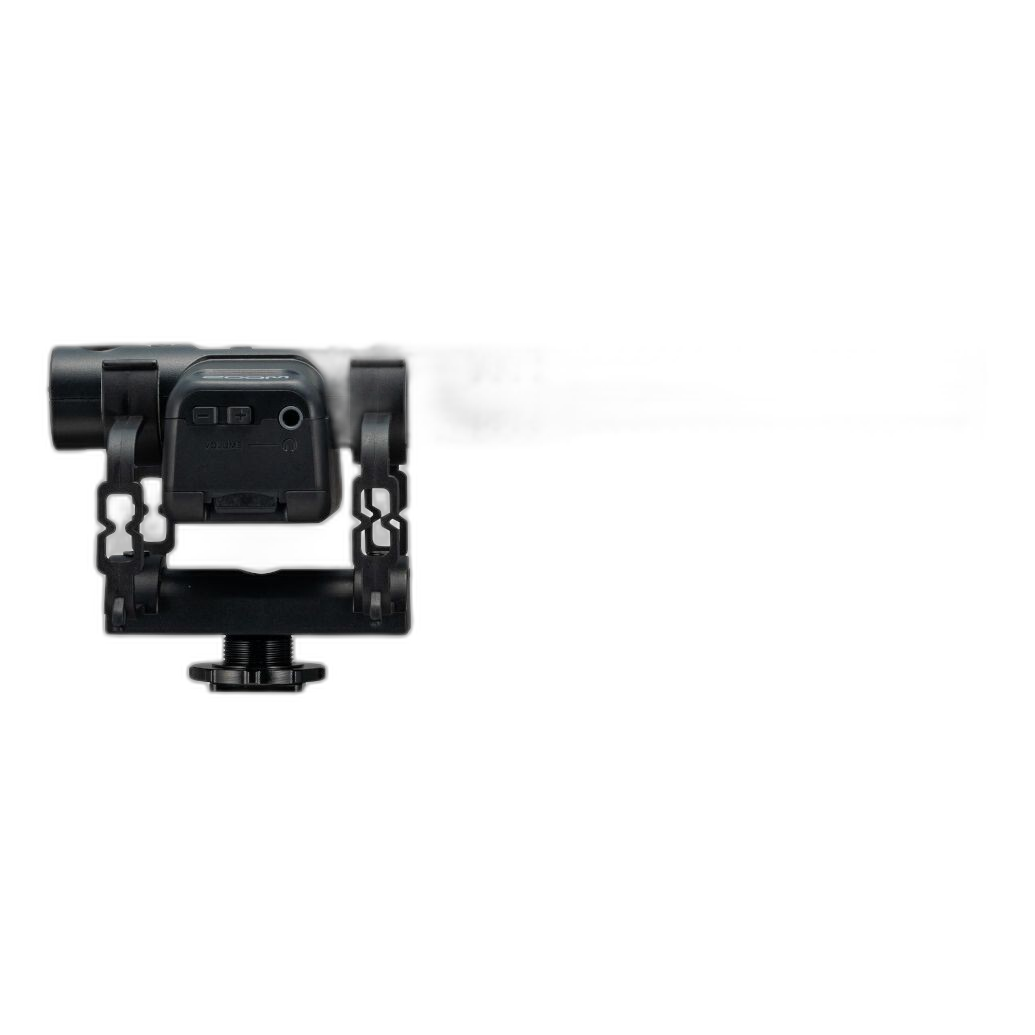
Camera-mounted recording in mono or stereo
The Zoom M3 MicTrak Stereo Shotgun Microphone and Recorder costs $199.99. Choose it for camera-mounted audio when the job includes dialogue as well as ambient sound. It combines a shotgun microphone with a recorder, so the recording goes to a card in the M3 rather than depending entirely on another device to capture it.
The M3 records two-channel audio at 48 kHz in 32-bit float, with no gain adjustment needed. Its mono mode uses the supercardioid mid microphone for dialogue. Switch to 90° stereo for a narrower stereo capture, or 120° when a broader sense of the surroundings matters. Those choices separate it from the lavalier recorders and mono podcast microphones in this lineup.
A hot shoe mount handles camera attachment, and the supplied shock mount is designed to reduce handling noise. The separate 3.5mm headphone and line outputs provide monitoring and an audio connection to another device. That leaves a way to listen while maintaining an output connection.
Zoom rates alkaline battery life at about 12 hours from two AA batteries. USB-C bus power is another option, and the USB-C port also supports data transfer. For recording media, Zoom specifies 4–32GB microSDHC cards or 64GB–1TB microSDXC cards. This is the choice here for onboard recording with selectable mono and stereo pickup.
Lavalier recorders with optional Bluetooth control
The Zoom F2 Portable Field Recorder with Lavalier Microphone is $99.99. The Zoom F2-BT is $109.99. Both suit spoken-word recording when the microphone should stay with the person rather than on the camera. Each includes an interchangeable omnidirectional electret condenser lavalier.
Both record 32-bit float files at either 44.1 kHz or 48 kHz without requiring gain adjustment. The lavalier connects to a 1/8-inch microphone input with 2.5V plug-in power. Screw-lock connectors help keep that connection secure, while the Rec Hold function guards against accidental button operation after recording starts. Those are useful distinctions for a recorder that may be carried on the person speaking.
The F2-BT adds built-in Bluetooth and wireless timecode synchronization. With Zoom's F2 Control app, it can remotely start or stop recordings and display battery levels. Bluetooth here supports control and timecode functions; the lavalier still connects to the recorder's microphone input. Choose the F2 if operation at the recorder is sufficient, or the F2-BT if those additional functions belong in the workflow.
Both have an 80 Hz low-cut filter, which can reduce low-frequency rumble, and a stereo 1/8-inch headphone/line output with dedicated volume control. They record to microSD, microSDHC or microSDXC cards up to 512GB. USB-C connects them to F2 Editor for settings.
Each recorder weighs 32g without batteries and uses two AAA batteries. Zoom lists continuous recording times of 15 hours with alkaline batteries, 10 hours with NiMH and 18 hours with lithium. The choice between these two is therefore primarily about Bluetooth functions, not a different recording format or battery rating.
An XLR podcast pack for a separate recording setup
The Zoom ZDM-1 Podcast Microphone with Accessories costs $99.99. It suits a desk-based voice setup built around an XLR recording input. The pack includes a dynamic microphone, closed-back headphones, an adjustable tabletop stand, a foam windscreen and a 2-meter XLR cable. The cable is an XLR connection, not a direct computer connection.
The ZDM-1 is a mono, end-address microphone with a supercardioid pickup pattern. Speak into its end rather than its side. That directional pattern makes microphone orientation important: aim the pickup toward the speaker instead of treating it like a microphone intended to collect sound equally from every direction.
Zoom lists a frequency range of 50 Hz to 18 kHz, sensitivity of -54 dBV/Pa and a maximum sound pressure level of 135 dB SPL. The microphone has metal construction and an internal shockmount. Its mounting hardware accommodates 3/8-inch-16 and 5/8-inch-27 threads. Buy this pack for its XLR connection and dynamic microphone design, not simply because it includes more than a microphone.
A USB podcast pack for computer recording
The Zoom ZUM-2 USB Podcast Mic Pack also costs $99.99, but it takes a different route to recording. This is the pack to choose for podcasts or streaming directly on a computer. The microphone uses USB power and has a USB Type-C port.
The included equipment covers the physical desk setup: closed-back headphones, an adjustable tabletop tripod, a foam windscreen and a 2-meter USB cable. Unlike the ZDM-1 pack's XLR cable, this cable provides the computer connection. Start with that distinction before comparing the microphones' other specifications.
The ZUM-2 is a mono condenser microphone with a supercardioid pickup pattern. Zoom lists a 20 Hz to 20 kHz frequency range, -35 dBV/Pa sensitivity and a maximum sound pressure level of 135 dB SPL. Its listed frequency range extends beyond the ZDM-1's, but the more useful purchasing distinction for a spoken-word desk setup is still USB versus XLR. Choose the ZUM-2 when the computer is where recording will happen.
Stereo recording for Lightning devices
The Zoom iQ6 XY Stereo Microphone is $89.99. It is the choice for stereo recording through a Lightning-equipped iPhone, iPad or iPod touch. Check the device connector first: the iQ6 uses Lightning, not USB-C. It draws power from the connected device.
Its two unidirectional condenser microphones use an X/Y arrangement, adjustable to 90° or 120°. That gives a choice of stereo coverage for recordings such as concerts or meetings. It supports resolution up to 16-bit/48 kHz and is compatible with Zoom's Handy Recorder app. Unlike the M3, it puts the microphone on the mobile device rather than combining a camera-mounted microphone with its own card recorder.
The iQ6 has an analog-style microphone gain wheel with an adjustment range of +11 to +51 dB, plus a three-segment LED indicator. Gain control is part of operating this microphone, unlike the gain-adjustment-free 32-bit float recorders above. A 3.5mm headphone port provides a listening connection, and a removable spacer helps accommodate a device case. Buy it for the Lightning connection and adjustable X/Y stereo pickup.
How to choose
- Audio recorded at the camera: Choose the M3 for its onboard recorder and switchable mono, 90° stereo and 120° stereo modes.
- A lavalier that stays with the speaker: Choose the F2. Choose the F2-BT instead when remote recording control or wireless timecode synchronization matters.
- Podcasts recorded directly on a computer: Choose the USB-connected ZUM-2 pack.
- A voice microphone for an XLR recording input: Choose the ZDM-1 pack. Its included cable matches that connection.
- Stereo recording on a Lightning device: Choose the iQ6, after checking the device's connector.
All six products are in stock at Unique Photo.
Prices at Unique Photo
- Zoom M3 MicTrak Stereo Shotgun Microphone and Recorder: $199.99
- Zoom F2-BT Portable Bluetooth-Enabled Field Recorder with Lavalier Microphon: $109.99
- Zoom ZDM-1 Podcast Microphone with Accessories: $99.99
- Zoom ZUM-2 USB Podcast Mic Pack: $99.99
- Zoom F2 Portable Field Recorder with Lavalier Microphone: $99.99
- Zoom iQ6 XY Stereo Microphone: $89.99
Prices as of November 16, 2026. Browse more: Microphones, Zoom at Unique Photo.
Frequently asked questions
What is the difference between the Zoom F2 and F2-BT?
Both record 44.1 kHz or 48 kHz audio in 32-bit float without gain adjustment. The F2-BT adds Bluetooth control and wireless timecode synchronization; it costs $109.99, compared with $99.99 for the F2.
Should I buy the Zoom ZDM-1 or ZUM-2 for podcasting?
Choose the ZDM-1 for an XLR recording setup or the ZUM-2 for a USB connection to a computer. Both packs cost $99.99 and include headphones, a tabletop stand, a windscreen and the corresponding cable.
Does the Zoom M3 record audio without a separate recorder?
Yes. The M3 has a built-in recorder that captures two-channel 48 kHz/32-bit float audio to microSDHC or microSDXC cards.
Does the Zoom iQ6 have a USB-C connector?
No. The iQ6 uses a Lightning connector for compatible iPhone, iPad and iPod touch devices, and it receives power from the connected device.