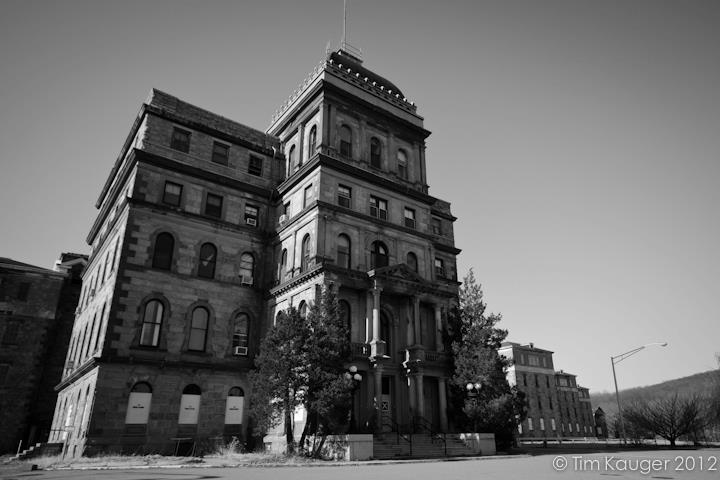

Greystone Park Psychiatric Hospital, NJ
We've all seen it: that creepy, abandoned building that we pass by during our daily life, a solemn reminder that even the biggest structures we create are finite. For some people, the feelings of mystery and intrigue of these neglected places are too great to ignore. They call themselves "urban explorers", and they're just that: adventurers in the wilderness of derelict buildings, tunnels, and anyplace else that humans built and then forgot about. A growing faction of worldwide photographers are exploring these places for themselves, since these structures will inevitably be razed or will crumble from the erosive effects of wind, water, and gravity. In this post, we'll look at not only the aesthetic of urban exploration ("urbex") photography, but also the dangers of this kind of undertaking (because believe me, it can be extremely hazardous).
Capturing the Neglect

Superstructure - Copyright Ed Roppo
The bulk of urban exploration photography takes its method from architectural photography. Generally speaking, many photographers in this field employ tilt-shift lenses and/or post processing to make doorways and walls as vertical as possible to avoid the "funhouse" effect of wide lenses. Of importance is the balance of images, as well; the best images often employ the four-thirds rule of composition as well as recognizing symmetry in structure. The most common way to light these images is via the natural light entering the area from windows or skylights (and in some cases, holes in the ceiling). Bracketing and HDR processing via software is also popular due to its ease of use and fine-tuning controls. Additionally, light-painting with flashlights can often create a specific mood for a photo or just to simply light a part of a dark room. Some have experimented with strobes, but in urbex photography, the less equipment to carry the better. Having a keen eye for surroundings is important as well; images are often everywhere, in small details like discarded papers and tools all the way up to the complex framework of entire factories. All of these tips, however, are general guidelines and not hard-and-fast rules, as photography often is; the creativity of each individual shooter is what matters most.

I bent the "rules" a bit with a fisheye lens at Eastern State Penitentiary
What drives the urbex photographer? According to Ed Roppo, a.k.a. Rustyjaw on his website, "the history of the locations, how people think about the places they dwell in, and the transient nature of even the most substantial structures - each of these enters my awareness at various times while exploring and shooting abandoned places". This is a common explanation among the ranks of urbex photographers: to document the stark contrasts between the glorious heyday of these structures, and their subsequent tossing aside, a memory breaking down into the essential elements of nature once again.
The Dangers

Copyright Tom Kirsch
Urban explorers are a risk-taking bunch. Many abandoned properties around the world are owned by local and/or state governments, as well as private owners. That being said, these places often carry "No Trespassing" signs. The risks people run from breaking these rules vary, but the outcome is rarely good if you're caught in or around these buildings without permission. In a correspondence with a local police officer regarding a particular abandoned property, I was told that 10-25 people are arrested on the spot at that particular location every week, many from places as far as Great Britain and Australia(!). Securing permission to photograph these locations is of utmost importance if you don't want to risk a police record or spend time in jail. According to a popular urbex photographer in an email correspondence, private owners of properties are generally more open to letting in photographers than are companies or governments who own the buildings, provided they seek permission in advance. Some "abandoned" locations are actually open for tours to the public, such as Eastern State Penitentiary in Philadelphia, PA. Just because a formerly abandoned place is open for tours doesn't disqualify it as urbex photography; many of these places are purposely kept in a state of disrepair for the full experience of decay. But the bottom line is this: urban explorers enter the majority of abandoned property at their own risk, and must be prepared for the consequences on their own if caught by authorities or property owners on these grounds.

Abandoned Water Pump Building, 2011
More practically, there are health concerns while urban exploring. Many of these places are poorly ventilated, thus black mold, dust, asbestos and radon are all floating in the air like a toxic soup. Urban explorers take care to not spend an inordinate amount of time in these locations, and often wear painters' masks - sometimes even gas masks - to prevent inhalation of these chemicals. More importantly, floors are often a concern, as sometimes they simply aren't there. If floors exist, they may give way at a moment's notice, commonly if they are wooden and are soaked through from years of seeping rain. Every part of these buildings, as photographically bountiful as they might be, carry the risk of scrapes, cuts, and bruises over uneven floorboards, jagged rusty nails, broken glass and peeling paint. If indeed one is lucky enough to secure permission to enter an abandoned location, insurance waivers are often signed in case of injury.
Weighing the Risk vs. Benefits
 Precarious (Tom Kirsch)
Ultimately, it comes down to how much an individual is willing to risk in capturing images of these abandoned places. Often, the conviction to create photographs can override caution and discretion, which can be a dangerous habit in the midst of all the "what-ifs" that exist in this field. Through personal experience, many of these places have a rich history behind them, and the potential photographs are seemingly infinite, but it is equally important to respect not only law enforcement but the locations themselves. There is no single answer to the question, "Is it worth it?", because it's up to every individual to decide how much they are willing to gamble to create these images.
As the adage goes: Take nothing but photographs, leave nothing but footprints...
Tim Kauger is a blogger and photographer based in Short Hills, NJ. You can visit his website here.