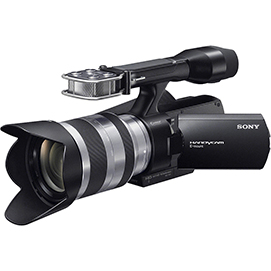
by Eddie Whittington [caption id="attachment_2135" align="alignright" width="221" caption="The New Sony NEX VG-10"] [/caption] There has been a lot of talk…
by Eddie Whittington [caption id="attachment_2135" align="alignright" width="221" caption="The New Sony NEX VG-10"][/caption]
There has been a lot of talk about the new wave of camcorders and HDSLR cameras hitting the market these days. It seems like every other day a company comes out with a new product that they claim will revolutionize the industry. At times it can be a bit overwhelming, so I thought I could help clarify some of the information because when purchasing new gear it is always important to analyze what you will be using it for. For the past couple of days I have been fortunate enough to get my nerdy little hands on the new Sony VG10, the first interchangeable lens camcorder. My first impression is that it's pretty awesome!. Sony has created an amazing camcorder that also happens to take great still photographs. Typically still shots are an after thought for camcorders and until very recently HD video was an afterthought for DSLRs. The viewfinder, fold out LCD, and grip of the camera make it easy to shoot video on the fly instead of having to use a DSLR with an expensive rig, eyepiece, and monitor. This is a big selling point for me. Keep reading for the rest of my thoughts on the VG-10 and a sample video I made.
The 18-200mm kit lens is a nice match for the APS-C sized sensor (1.5x) in the VG-10. It has an equivalent angle of view that a 28-300mm lens would on a full frame sensor. That is quite a bit of coverage. One thing I did find a bit annoying is the lack of automated zooming with a switch/lever. It must be done manually with the lens. This is the trade-off for having a bevy of great interchangeable glass. You can use the 16mm 2.8 and 18-55mm F/3.5-5.6 which are both Sony E-mount lenses. With an adapter all of Sony's A-mount lenses can also be used. The auto-focus is solid and up to the level I have come to expect from Sony NEX cameras using E-Mount Lenses. A recent update means there is auto-focus functionality when using Sony’s LA-EA1 adapter with their A-Mount DSLR lenses
[caption id="attachment_2138" align="aligncenter" width="300" caption="The Sony LA-EA1 A to E mount Adapter"][/caption]
Now for some real "techie" stuff...
With the surge of popularity in HD DSLR video, there has been a lot of discussion about frame-rates such as 24p, 30p, 60i, etc.. I know I am sure to get a lot of flack for this, but the VG-10's lack of the 24p frame-rate is only important for those interested in serious video production who want to achieve a “Cinematic” aesthetic to their projects. For everyone else, it really doesn’t mean much at all. This is a great camera with a solid feel, great quality video, and strong low light performance because of the APS-C sized sensor. I find it a great choice for anybody that wants to capture beautiful image quality straight out of the box. The quad-head microphone is actually really nice too. So From capturing the winning touchdown at your kids game or filming "run and gun" style documentary, the Sony VG-10 will deliver. Sony really has a winner with the VG-10. As much as I love the cinematic quality of my 5D Mark II at 24 fps, my needs for that camera are not the needs of the masses. Comparing the two cameras really isn't fair anyway. At around $2,500 body only, the 5D Mark II isn't truly a good video camera until you add on a viewfinder and other accessories which rack up in price. Then there is purchasing lenses. For $2,000 the NEX VG-10 comes with the excellent 18-200mm lens. Although both record HD video and have interchangeable lenses, they are targeted at two different kinds of customers. I see the VG-10 as a good "bridge" camcorder for someone who is looking to get great quality video, but doesn't want to spend $4,000 on a professional CCD camcorder or a DSLR + lenses/accessories type setup.
 [/caption]
 [/caption]