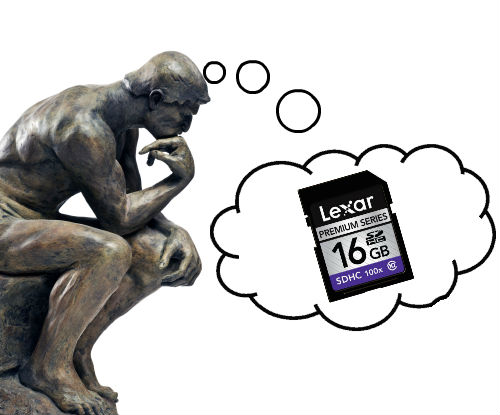
Ah, the bliss of memory cards. Remember when we had to walk two miles in the snow, sleet, and volcano lava to the camera store after we've snapped 36 frames with our cameras to buy more film? Nowadays, we transfer our photographic memories to a computer (or, hopefully, an external hard drive), and napalm them from the memory card, which then becomes a fresh blank slate. No buying more memory, no needing memory developed, no memory accidentally unraveling itself after a clumsy moment. Memory cards are great.
But guess what? You do need to buy more memory cards. More often than you think.
Granted, memory cards fail after long usage, but most of your memory cards (despite what some reports say) will live for a good twenty years with proper care. That's not my point. As cameras today take bigger images and higher-resolution video, they need to write this massive amount of data to the memory card, and quickly. What ends up happening to some people - myself, included - is that they will upgrade their cameras and continue to use memory cards purchased 3 or 4 years ago (almost a century in technological terms), which often have slow write speeds. Thus, the card will become a massive bottleneck - resulting in slow write speeds at best, and reading/writing errors at worst. I've had an old card fail on me during a paid restaurant shoot after trying to film in high-bitrate 1080p HD video; luckily this happened at the beginning of the shoot, but most people aren't as fortunate.
 Class 10 is the fastest type of memory card available and recommended for most newer cameras
So what can be done? Well, sorry buddy, you can't magically make your old memory cards perform like the new ones. Truth is, you need to upgrade your memory just as much as you upgrade other gear. A Class 10 memory card, as defined by the SD Association (read: memory boffins), must be able to write at least 10mb a second. That's the very minimum write speed that most newer cameras (read: ~1 or 2 years old) need; many Class 10 memory cards, such as the Lexar line, can write at speeds much greater than that. In a few years time, though, we'll probably need Class 15 or 20 cards, provided the memory makers keep this classification system.
So, while memory cards can and do last a very long time, they won't be optimized for new cameras past a few years. It's a consequence of how fast technology is moving. The next time you open your memory card holder, take a look at your arsenal. Need to upgrade? Visit our website to refresh your memory, as it were, and reduce the risk of losing important moments because of an outdated card.
Tip: If you are buying an SDHC or SDXC card for the first time, make sure your camera and memory card reader can support it.
Tim Kauger is a blogger and photographer based in Short Hills, NJ. You can visit his website here.