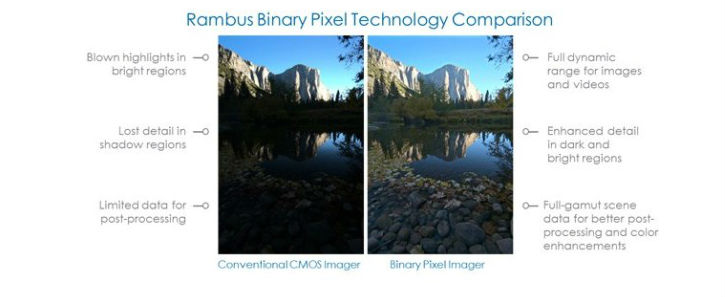
In yet another interesting development in the mobile photography game, hardware developer Rambus Tech has created a "binary pixel" sensor that may let your smartphone see like you do. If you've been a photographer for longer than a few minutes, you'll recognize that cameras can only replicate a certain brightness level in a single photo. This is why we need those clever tools we all take for granted, like strobes, lens filters, and multiple exposures for HDR. In essence, our eyes and brain adapt to all different levels of brightness, whereas cameras cannot. Until...now?

Rambus Tech has just made perhaps the most convincing solution to this problem. While technical explanations are still scant, the technology allows the sensor adapt to various light levels across the frame, much like how our mind and eyes let us see everything around us in "perfect exposure". It's like having a neutral density filter that varies its effect throughout the image space, so that you get a perfectly exposed photo in varied light conditions. Pretty freaking cool, if you ask me. Such ideas have been proposed before, to varying degrees of research and theory, but this sensor will likely be the first to be practically used. Here's my beef, though...it's being developed for mobile phones first. I understand why, since mobile phones are rapidly replacing the dedicated camera among various parties, and thus is the most lucrative platform on which to develop the sensor. I'm not trying to sound curmudgeonly, but photographic innovation should arise in cameras first. It's like a Honda Civic getting racing car technology before the racing cars do.
Still, so long as we, the camera faithful, get this technology too, I can't complain. Keep an eye on this...photography may be on the brink of another sea-change.