
[caption id="attachment_3968" align="alignright" width="210" caption="A crazy cave dweller makes an attempt at alchemy... I mean printing photographs. (theshadowbox.net)"]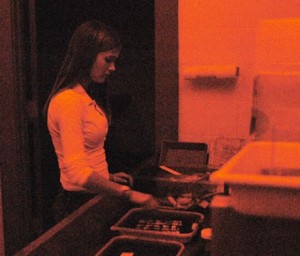 [/caption]
Hanging under the dim orange light, a print soaked in acetic acid stop bath is suspended in the air by bamboo tongs. It is then carefully placed into archival fixer and eventually an hour long wash. If left in a relatively stable environment, this print will remain in its original state for many years. Even more stable is the source this print came from, the gold old fashioned film negative! As long as you have it, you will always be able to make more prints. Although the romantic picture I painted (or developed?) of printing photographs only represents of small niche of weirdos like myself in today's hyper-fast and impatient digital world, the fact is there are billions of photographic negatives that have been printed in a wet darkroom that will be around for decades, and probably centuries. The fact that you could conceivably take a glass-plate negative from 120 years ago and make a print from it today speaks volumes about the quality of analog photography. There is no question that digital photography has made our lives easier, but does it hold the same or even similar archival properties that analog photography has? Let's take a look.
[caption id="attachment_3972" align="alignleft" width="125" caption="Let's hope DNG becomes the standard for archival digital files and companies get rid of their pointless/silly proprietary formats"] [/caption]
There are obvious pros to digital files instead of tangible plastic negatives. For one you can have infinite copies of a digital file. It can be burned onto a DVD, saved to an external hard drive, or even uploaded to somewhere in the "cloud" on a server half way across the world. The ability to do this without losing quality is great. Yes you could make copies of film negatives, but they would lose quality (sharpness, tonal range, etc...) even after the first copy. As long as you have a hard copy of a RAW file such as a DNG or TIFF, you will be fine saving as many separate copies as you want. Additionally, digital files are easy to send anywhere or everywhere in an instant. Sharing your images has never been easier, but keeping track of them in the long run may prove to be very difficult.
In 1937, Ansel Adams, perhaps the most well known and lauded photographer of all time almost watched his darkroom in Yosemite burn to the ground. He lost many of his negatives, but was able to salvage many of them and put out the fire with fellow photographic icon, Edward Weston. There are hundreds of us out there who have lost photography equipment and negatives due to theft or disaster, I just thought it would be nice to point out that it happens to the best of us. However what if digital technology existed in 1937? Ansel would have certainly kept another archive of his digital files back in Carmel, California. Personally I still think Ansel Adams would be shooting large format film if he were alive today, but that's for another post.
[caption id="attachment_3975" align="alignright" width="300" caption="If Ansel Adams lost hundreds of his photographs... What's going to happen to us?"] [/caption]
In today's digital world people are very careless about their files, I am the number one culprit and I have no shame admitting it. It is something I really need to address soon. Personally I just had my first experience with a hard drive that crashed. Fortunately I had most of, but not all of my photographs on an external hard drive. What is the proper protocol for preserving your digital files? Honestly I don't believe the technology has been around for a long enough period of time for us to have the right answer quite yet. There are of course those of you our there who are much more organized than I am, with hundreds of hard drives and backups all around the world and in outer space ;). This is a good thing because your files have a better chance of surviving the inevitable loss of data that is likely to happen over the years. With analog technology we've come to accept that things won't work quite as well when they are older. Ever listen to an old scratched record or CD? Wow I'm calling CD analog technology, I feel old! The same won't be true years from now with an old hard drive. When you plug in an old dusty hard-drive it's either going to work 100% or not at all. Here is a good explanation of this and why companies claiming to sell you high quality HDMI cables are full of it! While the actual hard drives and discs may start to deteriorate over time, this is only part of what I am referring to.
[caption id="attachment_3971" align="alignright" width="300" caption="Sadly film is a great medium that is considered obsolete by the lazy and sloppy digital world of 2011"] [/caption]
As people from my generation pass on from life, they will leave behind their digital files. This is a new phenomenon and situation we will have to address as a culture. Unlike physical photographic prints and film negatives, data needs to be maintained every ten years or so and it will be wise to keep copying the files onto new hard drives. Unless the person inheriting the digital files is dedicated to doing this, the files will eventually be lost. As rudimentary as it sounds, it is easier and much more in our human instinct (at least for now) to dig through an old shoebox of prints and not an old cardboard box filled with hard drives and plug them in to check if there are photos on them. Who knows what kind of file formats or physical connections,brain implants anyone? will be used 100 years from now. Photography itself is in its infancy compared to other art forms and digital photography is even more mysterious to those who aren't professionals or serious amateurs. While I am sure photo-nerds like myself will be able to access photos when we're sitting around in a retirement home projecting images onto each others iPads telepathically, I am concerned about the consumer who just wants to hang onto their precious family photos and mementos. I have a strong feeling that 20, 30, 40, etc... years from now we will have some very puzzled adult children looking for family photos on old brick hard-drives that have long since bit the dust.