A few weeks back, we featured the work of Robert Burley, which included a small preview of his new book, The Disappearance of Darkness: Photography at the End of the Analog Era. After seeing a selection of images from the book, I knew I had to pick up a copy.
What greets you initially is a small selection of essays - including one by Burley himself - carrying messages such as "lost art", the irony of photographing "the death of film with film", and the impacts of change in the photographic world. Described in the essays are the processes through which Burley photographed, the rise and fall of Kodak and Polaroid, and how the aesthetic of photography was and is shaped by technology among other topics. Much of it is opinion, and a bit of it seems a little self-serving at times. But enough words about the words. Once the pages turn to the photographs, the book takes on a more distinct and palpable feeling.

Warehouse and photo-chemistry building, Ilford, Mobberley, United Kingdom (Robert Burley)
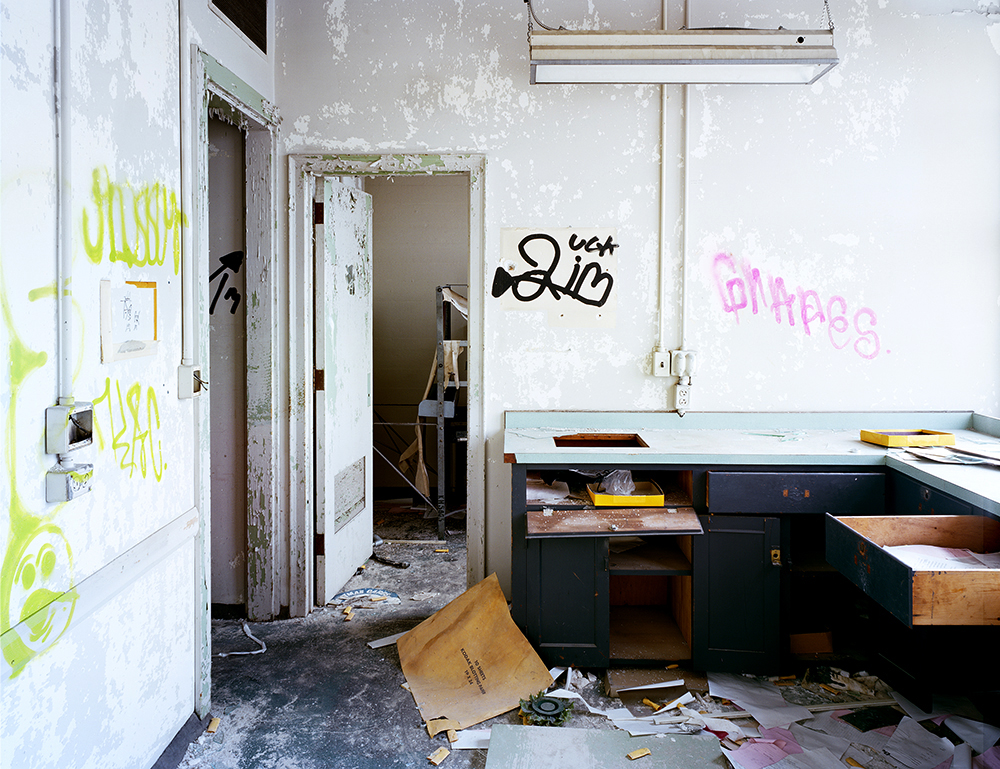
From a composition standpoint, Burley's work is extremely well balanced. The photographs are minimalist and composed distinctly in patterns, symmetry, and asymmetry. What's so special about them, however, is the distinct aura of abandonment and neglect throughout. The rooms, shelves, and spent film reels are pristine in their disuse, as if everyone simply up and left (which they most likely did). As a practitioner of urban exploration photography myself, I must thoroughly applaud Burley's efforts. He captures everything salient about an environment left behind: the machines that stand ready for the technician who will never return, the lockers that will never again hold personal belongings, and the lights - or lack thereof - that will never again illuminate possibility and promise.

Bulding 13, Coating Facility, Kodak Canada, Toronto (Robert Burley)
The book is organized so that the viewer can see every major company in the film industry as they stand now, emaciated and skeletal. Burley geographically covers the expansive to the minimal in each location, providing a comprehensive visual postmortem of the former photographic giants. In some cases, Burley documents the ultimate destruction of these remains, their years of manufacture and use reduced to clouds of dust and smoke. The book's residual effects on the viewer are sobering, as Burley has quite possibly created the most authentic look at the toxic, ruinous and rather immediate effect that the digital world had on film.

Employee Darkoom Area, Building 9, Kodak Canada, Toronto (Robert Burley)
If you aren't familiar with the book and are thinking of doing some research on it, feel free, but be warned: Burley has many of the book's images on his website, so don't look at too many if you plan to buy it. Of course, seeing them in print is entirely different, but I believe I spoiled my session a bit by looking at all of the images posted online. Still, I must recommend this book due to its very valuable insights into how our photographic world is changing around us. If nothing else, Burley demonstrates that film is just as relevant as it ever was, despite being battered and scarred by the digital sensor.
Tim Kauger is a blogger and photographer based in Short Hills, NJ. You can visit his website here.