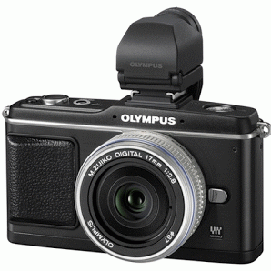
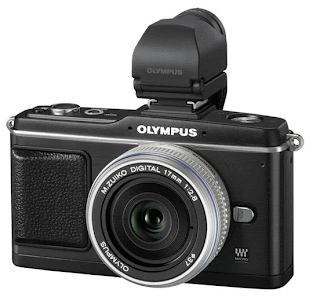
Take one look at the E-P2 and you might think this is a classic film camera. In fact, its design hearkens back to Olympus’ Pen series of film cameras. Even when holding the camera, it is easy to mistake it for a classic 1980s era rangefinder. The Olympus E-P2 embodies the epitome of class and style within its small frame.
Shooting with the E-P2 is an absolute pleasure. I had the camera with me for 4 days in Nashville at the Imaging USA trade show. I did not want to bring my heavy digital SLR, but I also wanted to avoid a traditional point and shoot camera, since most of my shots would be in low light, and that is where those cameras traditionally suffer most. The Olympus was the perfect middle ground. It's small and light enough for me to carry with me everywhere, all day, but has the large sensor and low noise that make for great indoor shots. The included 14-42mm zoom lens, a 28-84mm equivalent on full frame 35mm, is highly versatile; I rarely found myself wanting for anything more. This shot was taken inside the resort where the trade show was happening. Camera settings are indicated in the caption.

Olympus E-P2, Shutter Speed 1/5 sec, Aperture F3.5, ISO2500, 14-42mm lens at 14mm. No noise reduction applied, basic toning and color adjustments made in Adobe Camera Raw. Click to download the RAW file. Thanks to the amazing sensor-based image stabilization in the E-P2, I was able to successfully hand hold this shot at such a slow shutter speed. Photo by Josh Lehrer
When the camera is not in use, the lens retracts in on itself with a simple twist, making the camera even more compact. It's important to note that there is another option when purchasing an Olympus E-P2. For the same price, you can get the camera with a 17mm F2.8 "pancake" lens. This lens has a very low profile, it is so small that it barely protrudes from the camera at all. This lens is great for those who want a fixed lens with a fast aperture, and the smallest size possible.
To show how small this camera really in relation to what it can do, I put it side by side against the Canon Rebel XS, a small camera in its own right. The Olympus is dwarfed by the Canon, even with the Canon 50mm F1.8 lens mounted, which is one of the smallest lenses that Canon makes.

The large screen on the camera makes for a fine shooting experience, especially since the camera lacks any kind of optical viewfinder. The including electronic viewfinder performs well in normal conditions, but in low light, the viewfinder becomes increasingly grainy and hard to use. There is no built in flash on this camera, something that at first felt like a major omission. However, after seeing how well the camera performs in low light, and reminding myself how bad the typical direct flash pictures from a point and shoot look, I realized that the lack of a flash was not a problem at all. If you really do want a flash, the Olympus FL-14 is a small unit that goes right on the hot shoe of the E-P2.
Image quality of the camera is fantastic; jpegs, normally the weak spot of any camera, look great. The E-P2 also shoots RAW for those photographers who want full control over their images. I find myself wanting to take more pictures than usual, just because the camera is such a joy to use. With its current retail price of $1099, the Olympus E-P2 occupies a peculiar but lonely place in the digital camera market. It won't take the place of your digital SLR, and it won't fit in your jeans like a small point and shoot, but what it does do is bring the power, speed, and quality from a digital SLR into a small, light weight form factor. Features and gizmos aside, the Olympus E-P2 is the kind of camera that it is hard to put down, it is so easy to simply throw it over your shoulder and go that there is no excuse not to have it with you all the time.
In the chart below, you'll find test shots from the Olympus E-P2 at a variety of ISO settings, and also the same setup shot with the Canon EOS 7D and the Nikon D300s. (Please click 'Save As'.) While these full blown digital SLRs have larger sensors and cost over $500 more, and have the ability to use the full suite of Canon or Nikon lenses, it is remarkable how well the Olympus files compare, even at high ISO settings, usually what is essentially a kit lens.
| ISO Setting | Olympus E-P2 | Canon EOS 7D | Nikon D300s |
| 200 | Photo | Photo | Photo |
| 400 | Photo | Photo | Photo |
| 800 | Photo | Photo | Photo |
| 1600 | Photo | Photo | Photo |
| 2000 | Photo | Photo | Photo |
| 2500 | Photo | Photo | Photo |
| 3200 | Photo | Photo | Photo |
| 4000 | Photo | Photo | Photo |
| 5000 | Photo | Photo | Photo |
| 6400 | Photo | Photo | Photo |