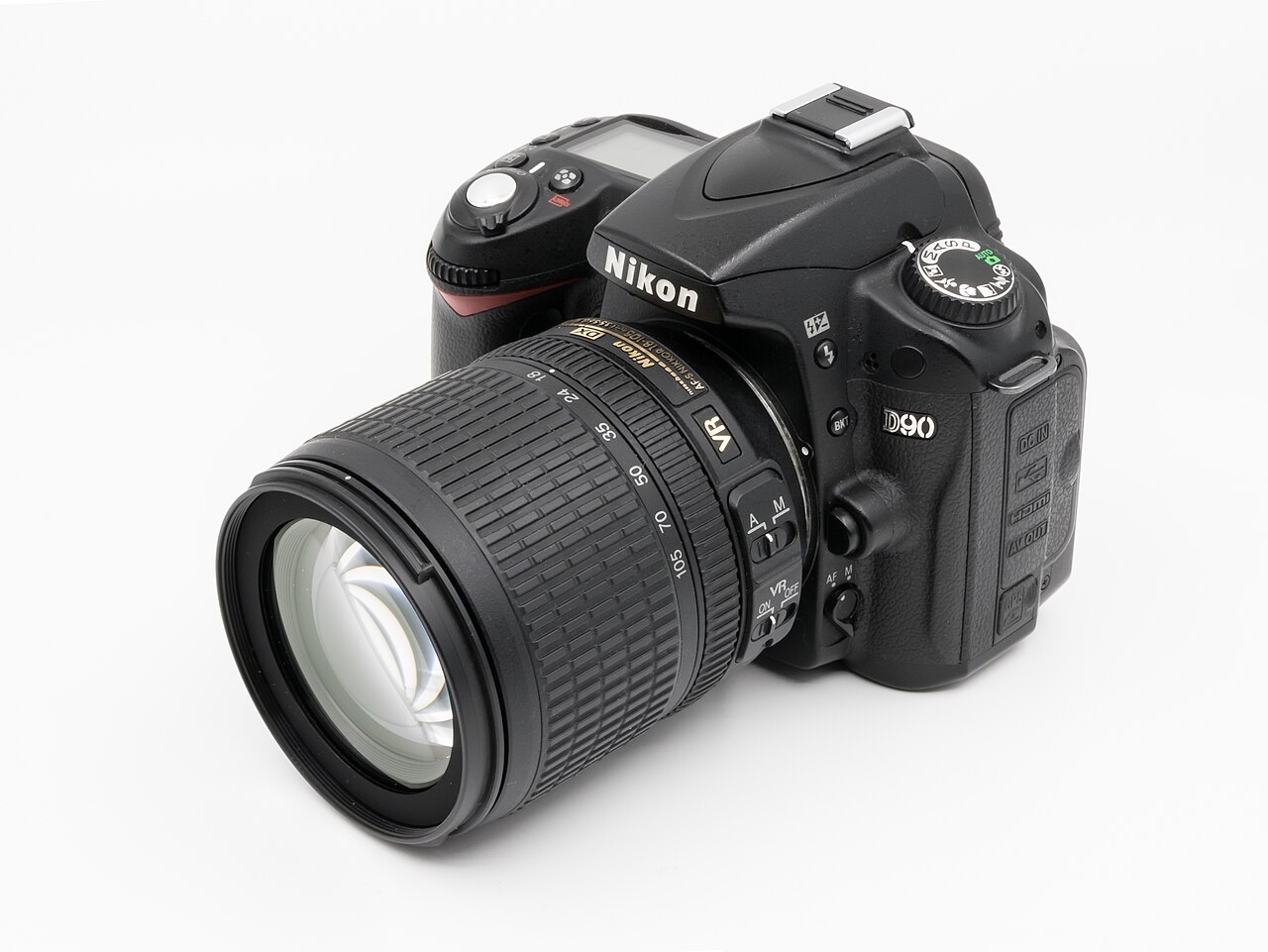
In late August 2008, Nikon introduced a camera that immediately stood out in the fast-moving DSLR market: the Nikon D90. At first glance, it looked like a natural continuation of Nikon’s enthusiast-friendly DX lineup, combining approachable handling with serious photographic tools. But one feature pushed it well beyond the usual product-cycle expectations. The D90 became the first DSLR to record video, marking a pivotal moment in camera history and opening a new chapter in the convergence of still and motion imaging.
For photographers following Nikon’s F-mount digital evolution, the D90 arrived as a highly compelling midrange model. It paired a 12.3-megapixel APS-C (DX) sensor with Nikon’s familiar ergonomics and lens compatibility, all at a launch price of $999. Yet its importance rests not only in what it offered photographers in 2008, but in what it signaled for the years that followed.
A Landmark DSLR Announcement
The Nikon D90 was announced on 2008-08-27, entering a market where DSLR buyers increasingly expected high image quality, responsive performance, and room to grow with a broad lens system. Nikon already had a strong reputation among enthusiasts and advanced amateurs, and the D90 fit squarely into that space. Its Nikon F mount gave users access to one of the most established interchangeable-lens ecosystems in photography, an important advantage for shooters who wanted flexibility across wide-angle, portrait, telephoto, and specialty optics.
What made the D90 truly historic, however, was its video capability. Nikon described a new possibility for DSLR owners: capturing motion with the look and lens versatility traditionally associated with larger-sensor still cameras. Today, hybrid capture is taken for granted, but in 2008 this was a startling development. The D90’s 720p video mode was not merely an added convenience; it was the first implementation of video recording in a DSLR, and that first mattered enormously.
Core Specifications That Defined the D90
At the center of the Nikon D90 was a 12.3MP APS-C (DX) sensor. In the context of 2008, that resolution hit a practical sweet spot for many photographers. It offered enough detail for serious everyday shooting, prints, and editorial work, while maintaining the speed and usability expected from a camera in this class. Nikon’s DX format also continued to appeal to users seeking a balance between image quality, manageable body size, and access to a broad range of compatible lenses.
The D90 used the Nikon F mount, reinforcing continuity with Nikon’s long-established system. That continuity was one of the camera’s strongest selling points at launch. Existing Nikon users could see the D90 not as an isolated purchase, but as part of a larger investment in lenses and accessories. For upgraders moving from entry-level bodies or film-era Nikon cameras, that system connection carried real value.
Its launch price of $999 positioned the D90 as an enthusiast-accessible DSLR with distinctly advanced appeal. It was not an entry-level novelty, and it was not priced out of reach for serious hobbyists. Nikon effectively placed a historically significant feature set into a camera category that many ambitious photographers were already shopping.
The First DSLR Video: Why It Mattered
It is difficult to overstate how significant the D90’s 720p video capability appeared at the time of release. Before this announcement, still cameras and video cameras were largely treated as separate categories for separate tasks. Compact cameras had offered movie modes for years, but DSLRs were associated with still-image performance first and foremost. By bringing video to a DSLR, Nikon challenged the idea that these devices needed to remain divided.
The significance was not only technological, but aesthetic. A DSLR with interchangeable lenses and a larger sensor than typical consumer camcorders suggested new visual possibilities. Depth of field control, lens character, and the handling familiar to photographers all became part of the conversation. Even if early DSLR video came with limitations that would later be refined across the industry, the D90 proved the concept. It showed that photographers could think beyond single frames and begin experimenting with motion from the same camera body.
From a historical perspective, the D90 belongs in any discussion of the hybrid imaging era. It was the camera that crossed the threshold first. Later generations would improve frame rates, resolutions, autofocus behavior, codecs, and audio support, but the breakthrough itself happened here. Nikon’s decision to launch video in a DSLR body changed expectations for what interchangeable-lens cameras could do.
A Camera for Enthusiasts at a Turning Point
Beyond the headline-making video feature, the D90 made sense as a photographic tool in its own right. The 12.3MP DX sensor placed it firmly in enthusiast territory, while the Nikon F mount made it attractive to a broad installed base of Nikon users. This was critical to the camera’s reception. The D90 did not ask buyers to embrace a completely unfamiliar platform just to gain a novel feature. Instead, it presented innovation within a recognizable Nikon DSLR framework.
That balance is part of why the D90 remains memorable. Cameras that make history are not always the most expensive or exotic models. Sometimes the most influential products are the ones that take a major new idea and put it into a practical, attainable form. The D90 did exactly that. It offered a familiar DSLR experience while quietly redrawing the boundaries of the category.
Seen from the perspective of its release period, the D90 would have appealed to several audiences at once. Existing Nikon photographers could view it as a versatile upgrade path. Enthusiasts comparing brands could see Nikon staking out a new technological claim. And curious early adopters of multimedia storytelling could recognize, perhaps before the wider market did, that the line between photographer and videographer was beginning to blur.
The D90’s Place in Nikon History
Within Nikon’s broader digital SLR story, the D90 occupies a distinctive role. It was not simply another step in sensor refinement or body design. It became a milestone camera because it introduced a function that would soon become central to nearly every serious interchangeable-lens camera category. Whether in later DSLRs or mirrorless systems, video recording would go on to become a standard expectation. The D90 is where that history begins in the DSLR space.
Its identity is therefore twofold. On one hand, it is a classic Nikon DX DSLR from the late 2000s, built around the strengths photographers expected from the brand: a proven mount, enthusiast appeal, and a practical balance of cost and capability. On the other, it is the model that helped set the modern template for hybrid capture. That dual character makes it especially important to collectors, historians, and photographers interested in the evolution of camera design.
Looking Back at a Pioneering Release
As an archival announcement-era camera, the Nikon D90 remains one of the most consequential DSLR releases of its generation. The combination of a 12.3MP APS-C (DX) sensor, Nikon F-mount compatibility, a $999 launch price, and groundbreaking 720p video gave it a profile unlike anything else on the market at the time. While later cameras would surpass it in nearly every measurable specification, the D90’s claim to fame has never depended on being the last word in performance. Its importance lies in being first in a way that reshaped the industry.
For anyone tracing the history of digital imaging, the D90 deserves close attention. It stands at the intersection of traditional DSLR photography and the coming wave of hybrid stills-and-video creation. To explore Nikon history, shop Nikon gear, or learn more about landmark cameras like the D90, Unique Photo remains a trusted place to buy, research, and stay connected to the story of photography.