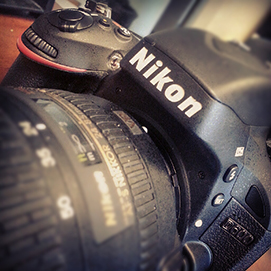
There comes a time in every boy's life when he must become a man. For some it's as simple as putting on a suit and going to work every day. For other's with expensive hobbies, stumbling over dreams of making a living off of art, we have to break the piggy bank and cry adult tears over the shattered remains of our savings accounts. We're all a little too disillusioned to believe in heartwarming fairy-tales of becoming the next Avedon, but it doesn't change the fact that we have this primal urge to upgrade our gear.
I recently graduated and with the diploma went my borrowing privileges of a D7000 that I had grown very fond of. I'd be humble if I bought my own, but unfortunately there was always this little bird pecking at my neck trying to talk me into spending more. In the past I've used the highly regarded D700 on various projects and always thought this would be the next logical step. Still I had envisioned missing out on better low light performance and video. My perception became blurred the moment I got my hands on a D800. I was blown away after my little test run, but a fellow coworker slapped the cherubs away from my head and reminded me that something was coming that would better suit my needs. I.E. less expensive, not as overkill. And so, the Nikon D600 has cometh.
They've been gaining much attention and since I had the money I figured it was worth the risk. The "risk" I'm referring to are the really minute details people have been picking at: WHAT DO YOU MEAN IT LACKS 1/3 OF A STOP SHUTTER SYNC SPEED...GAME OVER MAN. Sorry to call out Strobist, but seriously? Are they just being really picky, or does this camera have some major faults?
I decided I'd be an early adopter, but did I make the right choice? Click more for a first impressions written from the standpoint of a consumer who is looking to bridge the gap between DX and FX formats.  History Time with Grampa Nick (Why the need for a reasonably priced full-frame camera)
In short, those who have been shooting with a low to mid-level DSLR with crop censor for a while might understand the limitations of their cameras. Although these cameras feature ISOs up to 6400, the curse of digital noise is something that keeps us from considering it useful. There's also the significant jump in resolution detail... you could cram as many pixels that physics will allow onto a smaller sensor, but having a larger sensor with larger photosites means cleaner images in terms of dynamic range. Full frame cameras aren't for everyone...they're expensive, bigger, and have way more megapixels than some know what to do with. We could go on and on about the advantages and disadvantages of full-frame, so lets not.
There has definitely been a call to arms from consumers who want to create better images (hyuk), but one thing that keeps some at bay is price. You essentially have to buy an entirely new system complete with new lenses and that's just not easy for everyone. Sometimes if you complain enough (or put the hurt on a company that needs your money) they do answer your little consumer prayers. Alas, the D600 was forged and at it's announcement it was dubbed an "entry level" camera.
Allow me to expose my grinding gears for a second: A camera that costs over 2k isn't exactly budget. Sure it's less expensive than the D800, but It's still an investment like any other machine. Saying its cheap makes my head spin a little, they're making it sound like its made of recycled dunkin donuts cups and they replaced the sensor with a fun mirror.
There's also the whole "no frills" thing...I'm not sure what they're expecting, maybe a camera that has thermal heat-seeking autofocus, ISO 9,000,000 and also gives a laser light show when powering off.
Despite your definition of budget, I suppose this is as entry-level to full frame as we can get. If you're going to keep megapixels in mind, it surpasses or meets the pixel count of more expensive cameras. Its a bold move on Nikon's part, but the demand for quality is up there since everyone and their mother has a camera. One can argue that lowering the price is jumping into a swimming pool full of already hungry sharks, but if you think about it, expanding your clientele by introducing premium products to a much wider audience is ultimately the smartest move.
 Construction (Getting touchy feely)
With Full-Frame cameras you can usually expect them to be a little heftier. Generally there has be a little extra room to house that big sensor and pentaprism. For the tiny handed I'm sure larger cameras can be a little cumbersome, but in the same, those with barbarian hands might enjoy the additional hand space. Unfortunately with size comes weight. Full frame cameras like the D800 have bodies fully made out of magnesium alloy. Sturdiness is one of the fine qualities of these cameras. You're spending all that money, you're going to want a camera that can protect it's magical innards should it take a tumble. Funny enough, within hours of taking the D600 out of it's packaging, I dropped it in a typical clumsy maneuver by getting the strap caught on a desk drawer. Amazingly enough, not even a scratch. My heart however is still recovering from it exploding upon impact.
The size and weight of the D600 falls, you guessed it, somewhere in the middle of the d7000 and d800. It's not quite as chunky as it's big brothers. It feels well built and isn't so heavy that my arm would get toned from running around with it. This is partially due to not having a full mag-alloy body, which can be seen as a drawback. Although a little wider than it's DX counterpart, the D600 felt pretty similar except for the additional weight. A few of my mammoth-handed friends complained about the grip being a little cramped, but with my finger near the shutter (where it usually is) I didn't have my pinkie dangling from the bottom of it. I can see where those who are used to a much more spacious grip could have a case of finger claustrophobia, but with a battery grip I'm sure they'd be right at home. I'm just glad they made a slimmer full frame body without sacrificing external controls, which can be a real frustration. I was concerned about the mode dial sticking out, but it's not all that obtrusive. Seems like they chose from the best of both worlds in terms of button layout and overall ergonomics. Even minor adjustments like having an AF select button instead of three separate switches on the side seem like great improvements.

Operation (The Meat)
For the brief period of time that I have had the camera, I've been using it in a variety of conditions both indoors and out. One reason I opted for full frame was better ISO performance and thankfully I haven't been disappointed. Usually I'd never push the ISO past 800, but I was amazed that I wasn't drowning its color noise even at 3200. I'm also interested to see the highlight/shadow recovery at lower ISO, but overall I've been noticing a great dynamic range throughout. I'll have to compare test images in the full evaluation for a later date but if you're looking for numbers check DxO's ratings.
Focusing points are one of the specs that people get in a tizzy over. The D800 has 51 AF points while the D600 has 39 (15 vs. 9 cross-type). If this seems familiar to you, its because it's the same as the D7000, just crammed into the big ol' body. Since this type of AF system was suited for DX format, it seems kind of arbitrary to have all these focus points in the center of a larger frame. Often I found subjects with busy centers getting a little confused as it trying sporadically to pick the right point. This can be a little straining, but there's always the option to use 11 points rather than all 39. Either way I found the AF system to be speedy, true to previous Nikons I've used. Lastly, I'm glad they included an in-camera motor for non-AFS lenses. Although they're not the sharpest on the outside, it makes me happy that I can use my old film lenses with this new camera. Backwards compatibility is always a good thing.
Speaking of speed, there's been a little chatter about it's max shutter speed being 1/4000. I have to wonder when the last time I've shot anything at that speed (I guess this is due to shooting in difficult light situations or using flash), but I can only see that being an issue for bird photographers who refuse to lower their ISO. I guess it's more of a "why?" rather than a "deal-breaker." In terms of continuous shooting it can shoot up to 5.5fps (0.5 less than D7000...) I mainly shoot RAW, and the only times I ever use CH drive is when I want to make an animated GIF of one of my friends being weird. I can see this being useful for people who shoot sports and doubled with a faster memory card it can shoot pretty swiftly to catch any action.
Unfortunately I didn't get to test out video except for a few snippets, but one thing that caught me off guard is that you can't change aperture while live view is on...it's kind of a pain to have to turn live view off and on again just to adjust settings. There's also the 30 minute cap which I can see people getting upset about, but I'm sure music venues would enjoy that. I'd like to see how the video performs in low light as I hear that video get's muddy even after ISO800. Other than that the only reallly minor pet peeve is that it doesn't have a PC sync port. It's not really a big deal for many, as I'm sure those who use strobes likely trigger wirelessly via Pocketwizards and even if you prefer wired, you can buy a really cheap adapter that fits on your hotshoe. On the wireless topic, I wouldn't expect it to have in-camera WiFi capability for the price, but it would have been a really great add-on. With the announcement of the D600 they also introduced a new WU-1b Wireless Mobile Adapter. I'd be interested to see how well that works as I'm kind of an Android nerd and the work flow of going from camera to phone to internet could be pretty useful.
 Image Quality (The Potatoes)
Going from 16MP to 24MP there's a noticeable difference in overall image quality. We all make a note that it's not about the camera, rather how you use it...but making the jump you start to see the subtle qualities that make you understand why pro's rely on full format cameras. The colors are much more true and the dynamic range allows enough information to help some of your worst overexposed images. Like I said before, the ISO performance is a big win for this camera. Shooting at 1600 is no longer something I grit my teeth at. I always find that the best images I take aren't photoshopped to hell. When all the information is already there it means you'll have a lot less work to do in the long run.
Sure, overall sharpness has a lot to do with the lens and technique, but the detail rendering in comparison really blows you away. Zooming in at well past 100% you find that the textures are much more apparent and organic. Being as it doesn't have as the pixel count isn't as high as the D800, I haven't had much trouble with moiré patterns. There's also the plus that your file sizes aren't reaching 50-75MB per image. Storing and processing these large files can often be hindering rather than helpful. Unfortunately, and this is with any new camera, Adobe products wont be able to recognize any of the RAW files so you'll have to rely on whatever included software. In this case it's having a workflow through ViewNX 2 and I'm not so much a fan.
What else can you say? I'm really pleased with the first couple images I took and it's made me excited to go out and shoot again. Maybe that's just to assure myself that I've used my money wisely, but whatever. You can still make really terrible images with a full-frame camera. It's not magical. It's up to you to make the images you want, not the camera. 
Other Notes (Let's compare and my semi final thoughts)
So it's safe to say that I'm favorable of this camera overall. Perhaps it's more out of excitement that it's a suitable "camera for the rest of us" (I hate that term by the way), but I think others who are looking for a full-frame upgrade from a D7000 or 300s would really benefit from this camera. It even might make a very reasonable back up body for those with a D800 or D4. Is it fair to call this a "no frills" D800 lite? That depends on what you consider a frill and what you consider a necessity. In the same, is it just a full frame D7000 pro? I mean it has a some very similar features, but is it worth the extra money? That's something you have to decide.
To make things even more interesting, Canon introduced the 6D soon after Nikon announced the D600. It is also aimed as an entry-level full frame camera, has similar specs except for it being a little bit smaller and cheaper. Although it's too soon to compare the two cameras by just specs alone, there's going to be a million comparison reviews and the forums will be lit up. Final rant, I swear: I'm not a Nikon fanboy (I'm sure it's hard to believe after this article). The main reason I stick with them is because I already had so much glass from my film cameras. Other than that, I've always said I'd go with whatever worked. I just think it's humorous as I'm sure both companies had these two under their belts, just waiting to see who would make the first move. It's interesting to see how the market has changed and I wonder if more people will make the jump like I did. Maybe we'll even see those who aren't attached to either Nikon/Canon camp switch sides...I know a guy who did this once and he's thinking of doing it again. No names, but if you frequent this blog or come to the store you might know the big, lovable jerk. Is this D600 enough to win him back?
Whew, that was quite a bit for a "first impression" Hope my first "real world review" wasn't too much of a clunker. Samples I took are scattered throughout this article, but if you want to see more check here. We will soon have a comprehensive, no-holds-barred field test on the camera with further comparisons to see how well it did...hopefully in much scientific terms with the help of the aforementioned big guy.
Stay tuned folks.