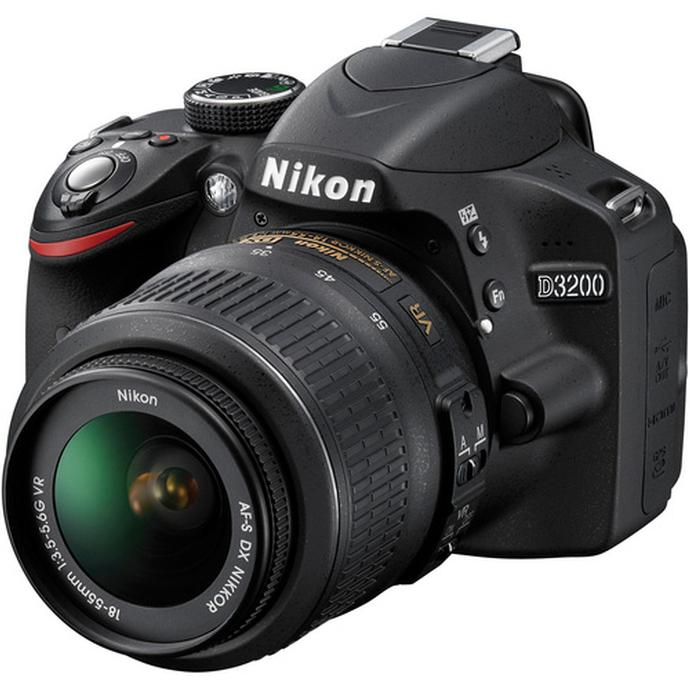
Nikon revealed its latest entry-level DSLR, D3200 in April 2012. The Nikon D3200 features the new 24 MP CMOS sensor, which is equivalent to the highest pixel count offered by Sony’s Alpha SLT-A65, A77 and NEX-7. In comparison to its predecessor D3100, the new Nikon D3200 features some subtle changes. Some of these changes include a 1080p video, a 920k dot LCD, and an additional Wi-Fi transmitter. However, the D3200 does not offer a built-in focus motor or even auto exposure bracketing. The Nikon D3200 comes with a simplified version of the Active D-Lighting function, which is a common feature amongst the company’s DSLR range. The biggest upgrade in this camera is the 24 megapixels pure resolution, which makes it the highest resolution DX-format body in the Nikon range.
Design and Build
Nikon D3200’s body is identical to its predecessor, the D3100. It measures 125 x 96 x 76.5 mm and weights 505 gm, which is almost the same as the D3100. This camera comes with the Nikkor AF-S 18-55 mm kit lens which is a bit bulkier than the Canon EF-S 18-55 mm. The lens of the Nikon D3200 comes across as well-balanced and provides vibration reduction (VR). An infrared remote sensor has been added to the grip and rear of the D3200. This remote sensor is compatible with infrared release and wired remote release cable.  D3200 Back The Nikon D3200 has a small button on the back which makes it easier to enter the Live View mode. The contrast detect method enables photographers to autofocus the camera in Live View. The camera does not provide any form of in-camera image stabilization, yet the 18-55 mm VR lens works as a good option for Nikon D3200.
Performance
The Nikon D3200 gives good performance overall and enables photographers to capture a focused image in less than 1.5 seconds after the camera is turned on. The processing speed provided by Nikon’s speedy EXPEED 3 image processor is quite impressive. This camera’s high resolution sensor gives fine quality images even for relatively large files. Also, while recording videos, the D3200 camera offers exposure control, which pre-sets the aperture and shutter speed. The Nikon D3200 has an optical viewfinder with positions of 11 auto-focus sensors marked permanently on the focusing screen. In single-point AF, the active auto-focus point lights up in red upon half-pressing the shutter release button. Some of the other available AF area modes include Auto Area, Dynamic Area and 3D Tracking.
Image and Video Quality
The Nikon D3200 camera produces excellent quality images. The settings from ISO 100 to ISO 400 give good quality images, but it starts getting noisy at ISO 800. This camera produces excellent night photographs devoid of red-eye, which normally doesn’t occur when the built-in flash is used. The camera features Active D-Lighting that maintains the shadow detail without removing the highlights in high contrast scenes. The Nikon D3200 camera features a Retouch menu that offers some good effect options which photographers can use for experimenting with the images. This camera comes with many digital filters to help customize the captured images. Some of these filters include color outline, color sketch, fisheye, miniature effect and sketch filters. Photographers can pick the picture style for a particular scene with the help of various preset options, such as standard, monochrome, neutral, vivid, portrait and landscape. The Nikon D3200 comes with the Guide mode app, which helps beginners to understand the basics of photography by helping them to choose the various kinds of settings and shooting situations that are suitable for capturing an image. The D3200 has a similar video mode like its predecessor, but Nikon has made a couple of enhancements to it. This includes manual control over shutter speed and aperture, which enables the D3200 to function as a more serious video capturing device. This camera has a built-in internal microphone which captures mono audio and also provides a connector for an external microphone for recording stereo sound. Photographers are given a choice of three video resolutions, which are 1920 x 1080 Full HD, 1280 x 720 HD and 640 x 424 SD. Similar to its predecessor, the Nikon D3100 comes with some basic video editing options to trim clips or extract individual frames as still images through the retouch menu. The camera also features an improved movie mode that provides more control over the exposure and sound. The D3200 produces good quality video output with smooth motion, no visible artifacts and low image noise levels when shooting in low light conditions. The D3200’s APS-C allows easier isolation of subjects and provides better creative flexibility than the smaller sensors of compact cameras.
Connectivity
Even though DSLRs are a far better option than smartphones for serious photography, most of them lack the advantage of connectivity. However, Nikon has released a WU-1a adapter with the D3200 camera. The WU-1a is a little Wi-Fi dongle, which connects to the camera’s AV port and enables photographers to transfer images from the camera to a smartphone or a tablet. In order to make this work, it is necessary to install Nikon’s Wireless Mobile Adapter Utility app on the device. This app makes the camera act as a Wi-Fi hotspot to connect the smartphone, and is available on Google Play store for installation.  Nikon WU-1a Adapter
Other Features
The Nikon D3200 camera comes with an EN-EL14 lithium-ion battery that was also used in its predecessor D3100. This battery has a capacity of 1030 mAh which is equal to approximately 540 shots. On switching to continuous shooting mode, photographers can get about 1800 shots.
Verdict
The entry-level D3200 offers a 24 megapixel sensor, which makes it the highest resolution APS-C DX format Nikon DSLR camera. The D3200 is ideal for amateur photographers or beginners who are looking for a DSLR-like experience. To view our entire selection of Nikon D3200's, click here.