"My little deuce coupe, You don't know what I got"
If there's anything to be learned from nature, it's that we shouldn't trust size alone to determine power. Small doesn't necessarily mean cute and meek...just ask the black widow, the poison dart frog or better yet the wet koala. This theory should also be applied to the digital jungle. The modern Point and shoot is no longer a laughable hunk of plastic. It's like they've been taking steroids that only affect their innards, quickly encroaching on DSLR territory. Despite packing more megapixels than you can shake a memory stick at, there's a strong distinction that isn't normally seen in a standard point and shoot: Larger sensors, fixed lenses and advanced manual controls with a classic inspired body. Naturally, these features aren't geared toward amateurs and are instead seen as a luxury. Thus, there is an appeal to the enthusiast.
Niche:Noun
A shallow recess, esp. one in a wall to display a statue or other ornament.
Hey, I'm not the one calling enthusiasts shallow...or wait a second, here's a better definition - "d : a specialized market" A niche market just means it's not for everyone, and considering the addition of "high-end" specs, there's usually a high-end price that follows suit. This tends to exclude a good bunch of perspective owners, regardless of how interested they are in it. Cameras that come to mind are Fuji's X100s and Sony's RX100, retro-inspired bodies with larger sensors that rival DSLRs in image quality. Recently it's all been a battle of the wits to see who can jam a larger sensor into a compact body. Of course Nikon would be silly to ignore this wave...The Coolpix A is their official entry into this race, enticing the high brow mainly with a DX sized sensor. So how does this little deuce coup fare amongst a growing line of large sensor compacts? Will it leave the competition in the dust or end up collecting dust on shelves?

Specifications of the Coolpix A:
-
TypeCompact Digital Camera
-
Effective Pixels16.2 million
-
Image SensorCMOS
-
Sensor SizeDX Format
-
Lens Focal Length18.5mm (angle of view equivalent to that of 28 mm lens in 35mm [135] format)
-
Lens f/-numberf/2.8
-
Autofocus (AF)Contrast-detect TTL AF
-
Focus RangeApprox. 1 ft. 8 in. (50 cm.) to infinity Macro close-up mode: Approx. 4 in. (10 cm.) to infinity
- Monitor Size
- 3.0 in. diagonal
- Movie 1920x1080p (30, 25, 24 fps), 1280 x720p (30, 25, 24 fps)
- ISO Sensitivity ISO 100-6400 (expandable to 25,600)

Look at the Coolpix A:
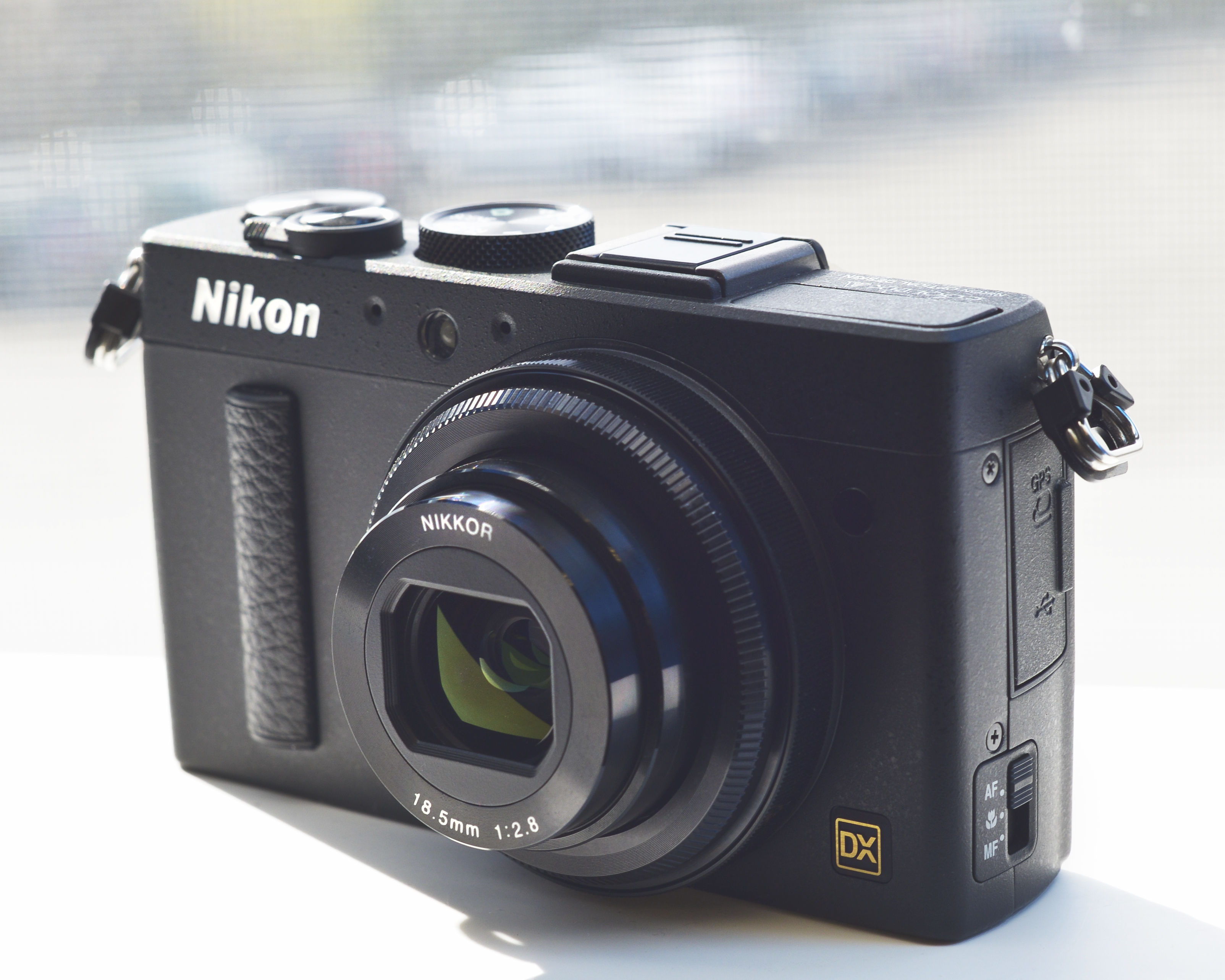
Very conservative in its demeanor, the CoolPix A sits sleek in an all black exterior; the Johnny Cash of compacts. You won't see any major frills here: Note its matte rectangular design, exuding a hint of finesse with brushed metal dials and an unobtrusive front grip hinting to the texture of an SLR grip...A subtle nod to the DX sensor hiding in this small package. The large LCD sits flush with the back, thumb grip unimposing, complete with a "Made in Japan" moniker to further enforce its quirkiness. Will you receive catcalls when you're walking down the street with it? Not unless it's from someone who knows cameras. What you see is what you get: A nice formal compact with an minor touch of pizzazz.

Pick up the Coolpix A:
The first thing you'll notice is its solid shell: Aluminum alloy on the front and back with magnesium alloy plate on top. The cold metal gives the understanding of ruggedness and yes, this ice queen feels expensive. Would you feel that you got your money's worth if your hands we're greeted with some kind of soft plastic exterior? Rhetorical question. Sturdy as it may be, it does feel a bit boxy and the hard edges aren't necessarily all that forgiving to your meaty hands...You'll notice that the strap anchor hangs out where your shutter finger wants to rest. Why would anyone want it there? This means you have to sneak the strap in between the webbing of your pointer and middle finger. Is it really that big of a deal Nick? I guess it is when the other hook is on the opposing side, like a boxer set in each corner of the ring. This just makes for awkward holding practice. Since the lens has a dedicated focusing ring, the camera can often be a two-hander. I'm not sure I found a comfortable way throughout my experience with it. You have ample amount of room on your right, but the left hand feels like its missing out. On the other hand (ha) the thumb grip is actually very comfortable with its soft rubber material. It might not provide the most non-slip grip, but still guarantees comfort. As for size: The Coolpix A is definitely coat pocket friendly, but good luck jamming it in your skinny jeans. Wear some more comfortable pants will ya?
Finally, there's the On/Off is switch which is activated with a flick of the trigger. It's kind of reminiscent of an advance lever on a film camera...Perhaps this is an ode to the old school? Turn on time is immaculately fast, almost so satisfying that you'll turn it on and off again just to hear it make its mechanical robot sounds. Quick turn on response is great for trying to catch that decisive moment and really helps drive home that this is an on-the-go type of camera.

Fiddle with the Coolpix A:
Once powered on you're welcomed to a nice bright screen with a smooth interface that's not too overbearing or in your face. Menus are straight forward, practically the same classic Nikon setup that's been recycled from their DSLRs. If you're familiar with them you'll be right at home. Everything is where you expect for playback, shooting, setup and retouching. The simple mode dial is fairly large, allowing you to easily see which mode you're on and although there's no locking mechanism, the dial won't easily turn in your pocket. Sitting neighborly to the mode dial and shutter release is an unnamed thumb dial that's used to select your priority exposure setting (shutter speed/aperture) or just the shutter speed when in manual. Circling the OK button is a thumb wheel that's primarily used to change aperture in manual, quick scrolling through menus and flying through preview images. This same thumb wheel is also a directional pad so you can press up down left right. With three ways of navigation I'm just glad there's no touch screen because it would have added more confusion.
On the left of the screen are four buttons: Exposure compensation, ISO, and two zoom buttons for preview. The ISO button also doubles as a customizable function button which can be swapped out for white balance, image quality, metering, bracketing, d-lighting and interestingly monitor brightness (what a bright idea for saving battery life). Either way, its nice to see that the ISO button isn't placed at the bottom left as with most of the recent Nikon DSLRs. For something that gets heavily used, that was a pretty awkward spot. Lastly there's the "i" button which is their quick menu. From here the exposure information is displayed along with most of your standard shooting options to change on the fly.
One thing that had me a bit befuddled was the lack of a dedicated movie button. For something that brags about quality HD video, they don't make it very clear how do this. In case you were wondering, you have to go through the release mode menu and scroll all the way to the bottom for movie mode...typically I wouldn't think to look there. It almost feels like a secret code you have put in, which isn't so much a great thing when you're trying to be spontaneous. Luckily there is another customizable function button next to the lens which I set to change release mode, allowing quick(er) access to video and continuous shooting. If it wasn't for that I'd be kind of cheesed, but it's still kind of annoying that there isn't a video setting on the mode dial...you know, where everyone else has it.

Take a Picture with the Coolpix A:
Overall speed and simplicity are the CoolPix A's strong points. Compose a shot without having grip anxiety and you'll notice a snappy experience. Of course there's brevity in shooting with almost any point and shoot, but here you also have the convenience of manual control to help you get the most out of your images. Just snap away and you're rewarded with swift and relatively quiet performance. I really liked toting the camera around on the street and found that its small size allows it to be less of an attention beacon compared to a SLR type camera. The downside is that you look like a tourist...something you'll just have to get over. Continuous shooting is a solid 4fps at highest resolution and even better the read/write isn't crippling with average speed cards. Mostly everything about this camera is quick and a joy to use...which leads me to something that wasn't so fast.
Focusing modes are limited to single-servo which allows you to prefocus on a halfpress and full time servo which is constantly attempting to lock on, something more optimal for those who use focus lock. Four different AF areas are available: Face recognition, wide area, normal area, and subject tracking. Trying out different combinations, I settled for single -servo in a wide area for most applications...and then Manual for when I got tired of it misfocusing altogether. Autofocus is the unfortunate a crutch of this camera. It's not necessarily mule speed, but it definitely has a problem with accuracy. I noticed some back focusing and a major concern was close focusing...From about 2 feet the camera begins to have issues. This seems to be a commonality with these larger sensor compacts that rely on a contrast detect type AF. The camera just disregards its macro focusing range unless switched on. To remedy this without turning on the slow searching Macro, you could half press the shutter and adjust the manual focus ring or use full manual focus. As you turn the focusing mechanism it makes a small "tick tick tick" sound which is kind of weird that it's taking incremental steps instead of smooth focusing. The contrast detect type AF also means it's iffy in low light...and with no image stabilization you're at the mercy of your hand's stability. AF issues sound eerily familiar to the RX100 and the x100 prior to its firmware updates. Unlike the the x100, you don't have to crank the focusing ring for it to respond, but maybe it could still be a little more sensitive. That sounds all sorts of wrong. Anyway, I get that there's a formula to these types of cameras, but maybe this is one problem that needs not be emulated, rather addressed. Regardless it does works fine in adequate light. Just don't count on it to be a wiz when you get up close and personal or expect sharp images in sub-par lighting.

Admire the Coolpix A:
After complaining about the autofocus, looking at the images out of the camera is almost enough to have me forgetting about my gripes. Judging images from the LCD is a definite no-no, but seriously it was like night and day once you see them on a big screen. Let's start with the sensor: It's supposedly the same Sony made chip found in the D7000. This is a tried and true formula for great resolution, but the difference here is the exclusion of an anti-aliasing filter. In theory this means sharper images with more detail resolution...all the while making you more susceptible to moiré patterns, which everyone seems to be deathly afraid of. I did notice generally sharper images and luckily I didn't notice the dense attack patterns assaulting my images, nor any crazy color fringing.
Images that you manage to get in focus are sharp as a tack throughout, even at it's widest aperture. Looking at the corner of the frame there's no noticeable softening or CA. Some might complain that the lens is "slow", but I think those people might have unreasonably high expectations already, so there's no chance at trying to appease them anyway. At f/2.8 the lens performs as well as it would at its sweet spot and since it has a DX sized senor you can get that nice shallow depth of field. The larger sensor also means that you'll get much more push and pull for light sensitivity, but there are still limitations that you would expect from a crop sensor. At ISO 3200 images feature some gain, but its not mottled with noise to the point where you will regret taking a picture. Even 6400, you get an image that's usable, but past that you get your standard mess. Click here to see an impromptu low light ISO test.
JPEGs out of the box are what you would imagine coming from a D7000, images aren't oversharpened and color reproduction isn't pushed towards exaggeration, and yet they're still aesthetically pleasing. Shooting RAW is really where you get the most oomph out of this camera. With it's uncompressed 14bit RAW files, you have the ability to heavily tweak the shadows and highlights without sacrificing detail. Really pretty amazing for such a small thing. Image quality is what this camera is all about in the end. You're paying the premium because of this and although it takes some finagling to get there, the reward is images that rival a D7000.

Stop Talking About the Coolpix A:
So, guy who skipped to the bottom of the article, where does that leave you and I?
Things I liked: It's a modest looking camera that takes DSLR quality images...and I'm not just saying comparably, more-so competitively. The build is nice, it's small enough for easy travel and has a top notch lens/sensor combination. I'd say this is really idealized for the enthusiast street photographer.
Things I didn't like: The focusing mostly. For such a snappy camera it sure slows down your ability to be spontaneous when you're constantly prefocusing, switching modes or ultimately giving up and trusting your own eye. Along with its general quirkiness and some frustrating ergonomics, the lack of image stabilization and a fixed 28mm focal length that tops out at a modest speed of f/2.8 makes one wonder why it's so expensive.
Is this the winner to the large sensor compact race? The end all be all? Well, I'll say it's a step in the right direction, but it's not perfect. It will probably take another attempt for Nikon to dial in what their hits and misses are. I think ultimately the Coolpix A falls a little short in operation. Without it's focusing problems I'd say it would be worth the money as your second shooter; your Sunday car that you take out for fun. I don't have one, but I'm assuming you do if you have the money to blow on a camera like this. Autofocus issues and other quirks aside, I think I'd still recommend this if you're looking for a powerful compact since its image quality is really top notch. If they can manage to fix some of their major issues through firmware updates, this camera has a chance to be one of the top contenders in its class. In closing a haiku:
Big sensor, Small size
High brow, Resolution wow
Why won't you focus?
Thanks for reading - Click here to see more sample images