.png)
Tis the season to take awkward family photos right after you've stuffed your face to oblivion...although there's not much you can do to keep your uncle from sipping too much spiked eggnog, here are a some simple tips that might make next year's Christmas card a little better.
If you have invested in a DSLR it's a good idea to buy an on-camera flash unit. Besides making you look like a seasoned holiday photographer, you gain the advantage of adjusting the direction of your flash. A common mistake of the amateur strobist is to point the flash dead on the subject. Taking pictures of your loved ones with head-on flash can make them look like a reindeer in headlights...not so flattering for next years Christmas card. By angling your flash to hit the ceiling, light will bounce onto your subjects, giving you a much softer and more natural looking fill light. An important reminder: change your white balance to the flash icon or else you'll get some funky colors. Chances are you'll want to take pictures around your ornately decorated Christmas tree. If you want more light to pop from the background you can dial down the flash set for rear curtain and use a slower shutter speed to burn in the background a little more.
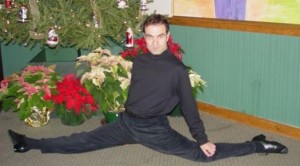
Sometimes controlling your lighting is easier than controlling your subject.
When taking pictures of delicious holiday desserts use a longer prime lens. Get close and stop down to a wide aperture so you get that nice smooth blur in the background. Shooting wide open can give an interesting look, but having a little more depth of field helps you showcase more than one morsel. Choose an interesting angle: You can get close to level with the plate to emphasize texture or you can shoot directly on top from a wider angle to showcase patterns. Use natural lighting when available and choose plating that compliments the color of your tasty treat. A simple white card can be especially helpful in reflecting light to fill in harsh shadows for more even lighting.
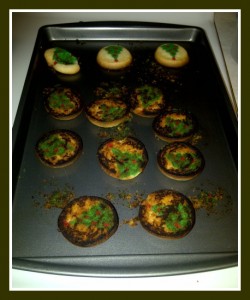
No amount of Photoshop can undo your "multi-tasking" in the kitchen.
Did you go all Clark Griswald on your House? Taking pictures of outdoor decorations can be easy if you want to see just lights, but you can make your house really stand out with a little bit of magic. Lots of cameras have on-board HDR these days...why not put it to use? If you're unfamiliar with the process it just takes a few different shots: one "proper exposure" and a few that are both under and over. What it does is stitch together these 3 or more exposures to create an image with a wider dynamic range...basically it blends enhanced shadows and highlights with the middle exposure. It's great to have this technology, but you still need to take a good picture first. Use a tripod. Don't try to hand hold because you'll get images with ghosting when the files don't line up correctly. Also they'll probably be blurry despite your image stabilization. Lastly you'll want to choose a time a day that isn't necessary fully dark. Shooting right after dusk where there's a little bit of blue left in the sky can make give interesting contrast to your houses intricate lighting setup.
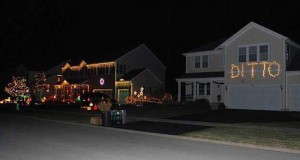
Eh, good enough.
Snow can set the scene for really a beautiful photograph, but your camera’s auto-mode will make your winter wonderland into a drab landscape. The brilliant white of snow confuses your camera’s exposure meter and chooses an exposure that makes everything look muddy gray. To remedy this you simply have to increase exposure manually or tweak the exposure compensation up a notch. In most cases you’ll need to increase exposure by at least a stop. A helpful way to get correct exposure is to spot meter for something that is actually middle gray (like a large rock) and use that exposure for the rest of the scene. If you’re finding the highlights of the snow too blown out, dial down a bit. It's always a good idea to turn down your ISO since the white of snow is so reflective, over-exposing causes you to lose highlights that are usually difficult to get back in post.
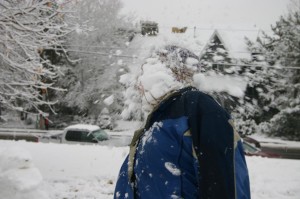
Snowballs might be a problem for face-detection.