The Canon EOS 60D was probably the most anticipated camera this summer. For a long time people have been speculating on the different specs, especially the…
 The Canon EOS 60D was probably the most anticipated camera this summer. For a long time people have been speculating on the different specs, especially the articulating LCD monitor. With the incredibly powerful 7D, many people wondered how Canon was going to slot in a model between it and the Rebel t2i. Well Canon managed to do it and overall I was very impressed. Canon has produced a camera that fits nicely between the t2i and 7D without sacrificing many features from previous models. Keeping reading after the jump/break for my impressions on the camera, a video review, and ISO samples.
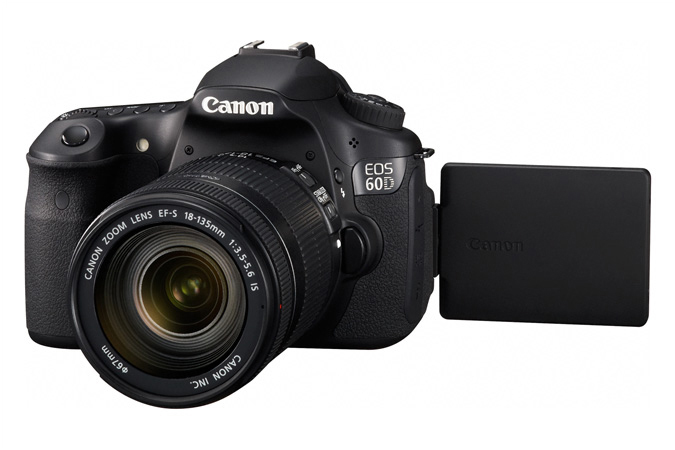
-The obvious first thing to list is the incredible high-resolution LCD monitor. It is a 3" widescreen with over 1 million pixels. It also folds out and can be useful for low/high angle video and still shooting.
 |
|
LCD Monitor folded out |
-The sensor is a tweaked version of the 18 Megapixel APS-C CMOS sensor found in the Rebel t2i and 7D. Image quality and noise levels should be nearly identical to both cameras, but we included an ISO test bellow and downloadable RAW (.CR2) files so you can make your own judgement As you can see in the video, the 60D is a smaller, more compact camera than the old 50D. The grip is more ergonomic and feels similar to the 7D, but not quite as sturdy.
 |
|
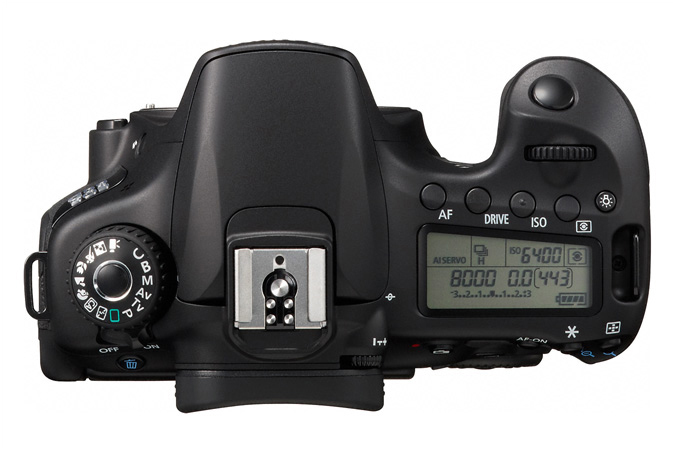
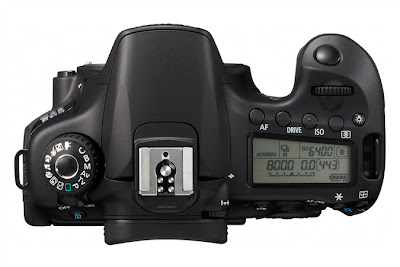
Top View of the 60D. Note the mode dial lock and single function buttons. |
-The mode dial now has a lock in the middle of it. To change shooting modes (or to access video mode) you need to hold the button in the middle of the dial down while turning it. The ON/OFF switch has also been moved to the position behind the mode dial, just like on the 7D. -The back wheel is less robust and now has a directional pad in the middle of it. The set button resides in the middle of the d-pad and it can be used through scroll through menus, changing AF points, etc...
 |
|
New button layout on the back of the 60D |
-A couple remissions and an addition here... Canon removed the PC-sync socket and changed the remote jack/port to be the same from the Rebel series. There is also a infrared sensor on the front grip of the camera for wireless remotes. -The 60D does not take CompactFlash (CF) storage media like the previous 50D, 40D, etc... Instead the 60D uses SD/SDHC/SDXC cards. The 60D also works with eye-fi SD cards. -The 50D didn't have any video functionality and it stuck out like a sore thumb in Canon's excellent lineup of HDSLR cameras. The new 60D records Full 1080p HD video at 24 or 30 fps. It can record 720p at 60 fps. I apologize for listing 24 and 30 fps @720p in my video review. IT IS 60FPS only when shooting 720p. There is full manual control over video and there is a special "crop" mode that lets you use only the central portion of the sensor to record standard definition video with a major crop on the lens, almost like a digital zoom on a point and shoot camera -Audio levels can be adjusted manually, just like they can on the 5D Mark II. This feature is not available on the t2i, 7D, or 1D Mark IV. -Viewfinder coverage is now 96% instead of 95% (50D) -The electronic level from the 7D has made it's way into the 60D, but only the horizontal level. Wow Canon really wanted to create some separation between models. No Yaw level, just tilt. Silly if you ask me.
 |
|
The pop-up flash can be used to command certain Canon EX Speedlites off camera. |
-The wireless flash commander from the 7D is also in the 60D, but with control over only 2 flash groups. Not sure why Canon limited this either. Just like the virtual horizon, it's a nice feature to have, but limiting it in the 60D wouldn't make anyone I know buy a 7D instead.
What I like about the Canon 60D
-The handling is very smooth and the camera is a breeze to shoot with, simplified buttons dedicated for only one function allow you to change settings easier without taking the camera away from your eye.
-The controls are also extremely customizable. I am one of those weird people who like to set up a camera with all the buttons changed. Personally it makes shooting easier and faster for me.
-The "Quick Control Menu" lets you change almost any shooting setting quickly, very nice feature.
-LCD is super high resolution and articulating. While some people call this silly/a gimmick, there are good uses for an articulating LCD monitor. Throw in the 1+ million pixels it has and the LCD can actually be a useful tool for low/high angle shooting for both stills and video.
-Full manual control over video, including audio level adjustments. Canon does DSLR video the way it should be, even in the lower level cameras like the t2i and mid-range 60D. It's something other big yellow&n bsp;manufacturer's just "don't get" and have probably lost a ton of market share to Canon in this regard.
-Same excellent LP-E6 battery as 5DMKII and 7D. Long battery life is a must with a camera so many people are going to be using for video. The charge time is relatively short. The LP-E6 is one of the best batteries out there.
-Same great image quality as 7D/t2i. Nothing to complain about here. Check out our ISO test bellow to confirm this! Very real sense of depth and texture because of the high resolution sensor. I would say up to 800 is very clean and 1600/3200 are usable.
-Added infrared sensor on hand-grip for remote shooting. This is a nice feature, not much else to say about it.
-Interchangeable focusing screens for making manual focusing easier.
-Inclusion of similar Wireless Flash Control and Electronic Level from 7D. Great add on features for this camera. The level works well and the Speedlite control is easy enough to use indoors for those looking to get into off camera flash photography. Outside it is a little more difficult and I would recommend using pocket wizards.
What I don't like about the Canon 60D
-The same old 9 point AF System as 50D. Granted all points are cross-type and very fast/accurate, but there should be some more assist points and they should be spread out more. I know this is a feature Canon is working on and has explained lack of accuracy when points are closer to the edges, so they've played in conservatively in this regard.
-Lack of dual media slots, SD Media is good for rebel shooters looking to upgrade, but bad for those with a 50D. Having a CF and SD card slot would have been an easy and brilliant move on Canon's part.
-Mode Dial Lock is a good idea, but annoying to use. How many times have you accidentally bumped the mode dial on your camera? Maybe once or twice, if that.
-The Unlock button under the control wheel doesn’t indicate whether it is “locked/unlocked” I don't understand when you wouldn't want to have the wheel or d-pad/set button locked? Maybe I just haven't used Canon cameras enough, but it seems kind of useless to me.
-Odd menu functionality when shooting video, options become accessible only when mode dial is set to video. I guess this is a feature to help guide consumers through the menus more easily, but I'm not a big fan of this. There should be a custom function to change this type of menu interface.
-Lack of dedicated White Balance button, but SET button can be customized for WB. However if you're like me, I set the d-pad to control the AF points without having to push another button (faster shooting). When you do this, you can't use the set button for WB because it is programmed to reset the AF point selection to the middle. Again not a huge deal for everyone, but after setting the camera up for how I like to shoot, this was a little disappointing.
-Removal of PC-Sync cord socket. Why? This seems like a silly thing to remove. Anytime you get less functionality out of a new model, it is never a good thing. I know most people use Pocket Wizards now, but it didn't seem like a PC sync socket would have taken up that much space.
-Removal of AF Micro-adjustment. Same as above, but even more bizarre because all Canon would have to do is include this in the firmware. I have seen a lot of people complaining about this. Most of it is typical internet "looking for something to complain about" type material, but every now and then you do get a lens that is slightly off in terms of calibration. Well if you own a 60D, it looks like you'll be sending your camera/lens in for service instead of being able to tweak it yourself.
Very impressive. I used a similar setup in the review I did on the Olympus E-PL1 and Nikon D3100. I have used the 7D on a few occasions and the results look similar. This is expected as the cameras use the same sensor and processor. (though the 7D has dual processors, but it doesn't seem to impact noise levels) However I personally think the 60D may look a smidge better. The files are here for you to make your own judgement of course. For an APS-C camera, the 60D is very impressive.
I shot this test in RAW + JPEG. The shot was manually focused and shot at f/8 for each shot to keep depth of field consistent. Picture Control was set to Standard. Here are the links to the RAW (.CR2) file downloads:
ISO 100 ISO 200 ISO 400 ISO 800 ISO 1600 ISO 3200 ISO 6400 ISO 12,800 Click the pictures below to see the full size JPEGs straight from the camera.
Yes the plush monkey I used is a shout out to Ken Rockwell, but his is in much better condition!
 |
|
ISO 100 |
 |
|
ISO 200 |
 |
|
ISO 400 |
 |
|
ISO 800 |
 |
|
ISO 1600 |
 |
|
ISO 3200 |
 |
|
ISO 6400 |
 |
|
ISO 12,800 |
Conclusion/Recommendations
I haven't had the chance yet to go take some "real" pictures with the 60D. There are certain things you can learn about cameras from spec sheets and test shots, but nothing does justice to a camera like a real day or two of shooting out in the real world with it. However based on these few brief moments I've spent with the camera I can tell it's going to be a very popular model. If you own any of the Rebel series cameras (maybe outside of the t2i), the 60D is a no-brainer. It gives 99% of the photographers out there every feature they need to make taking great photos a breeze. For those of you that own a 50D, you may want to consider a 7D instead. The 60D is an upgrade, but some of the lost features and switch to SD card media make the 7D a more attractive option. Right now the 7D is only $1,499. If you're one of the people complaining about the 60D missing features from the 50D, you should be buying a 7D. If you truly need those features, the small price difference should mean nothing, but for everyone else the 60D is a great choice.
 The Canon EOS 60D was probably the most anticipated camera this summer. For a long time people have been speculating on the different specs, especially the articulating LCD monitor. With the incredibly powerful 7D, many people wondered how Canon was going to slot in a model between it and the Rebel t2i. Well Canon managed to do it and overall I was very impressed. Canon has produced a camera that fits nicely between the t2i and 7D without sacrificing many features from previous models. Keeping reading after the jump/break for my impressions on the camera, a video review, and ISO samples.