Fujifilm’s X-series had already established a clear identity by early 2014: cameras with a strong photographic point of view, tactile controls, and image quality that won over enthusiasts looking for an alternative to conventional DSLRs. But there was also a consistent request from many photographers. They wanted the Fujifilm shooting experience in a more central-viewfinder, SLR-inspired body—something that felt immediately familiar in the hand while preserving the character of the X system. With the announcement of the Fujifilm X-T1 on January 28, 2014, Fujifilm answered that call.
The X-T1 arrived as a significant moment for the X-mount system. It combined the company’s proven 16.3MP X-Trans II APS-C sensor with a strikingly large 0.77x electronic viewfinder, a weather-sealed body, and the classic dial-driven ergonomics that had become central to Fujifilm’s appeal. Introduced at a launch price of $1,299, the X-T1 was more than just another mirrorless model. It was a statement camera—one aimed directly at serious photographers who wanted responsiveness, control, and durability in a compact interchangeable-lens platform.
A New Shape for the X Series
Before the X-T1, Fujifilm’s higher-profile X-series bodies had often leaned toward rangefinder-inspired styling. Those cameras were widely admired, but not every photographer prefers an offset finder design. For many users coming from decades of SLR and DSLR shooting, the central finder remains the most natural way to compose an image, especially when working quickly or with longer lenses.
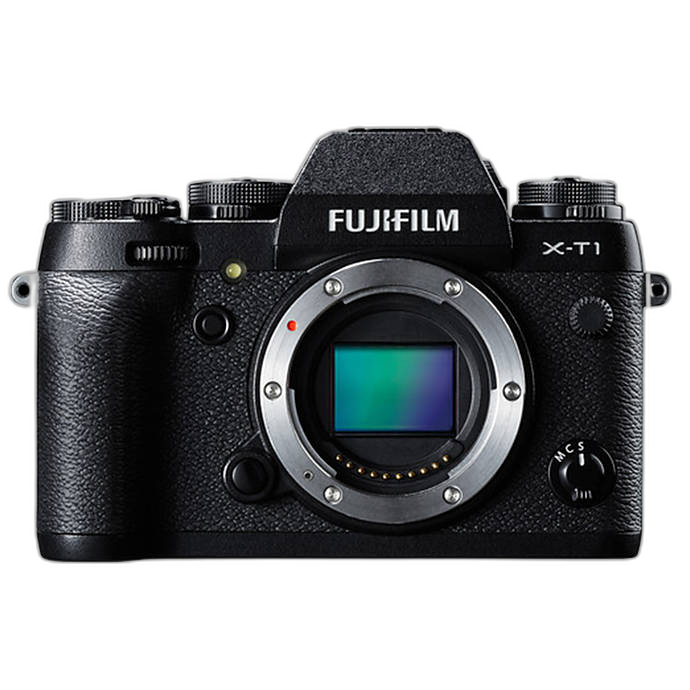
The X-T1’s silhouette made Fujifilm’s intent unmistakable. Its pentaprism-style top profile gave the camera a familiar stance, but this was not a nostalgic exercise for its own sake. The design served a practical purpose: it housed one of the camera’s headline features, the large electronic viewfinder, while also creating a balanced body shape that many photographers would find comfortable and confidence-inspiring.
At the same time, the camera remained recognizably Fujifilm. Dedicated top-plate controls reinforced the company’s philosophy that exposure settings should be visible and directly accessible. Rather than burying the photographic process in layered menus, Fujifilm continued to prioritize a hands-on interface that encouraged deliberate shooting.
The 16.3MP X-Trans II APS-C Sensor
At the heart of the X-T1 was Fujifilm’s 16.3-megapixel X-Trans II APS-C sensor, a format and sensor design that had already helped define the early success of the X system. By 2014, the X-Trans name carried real weight among photographers who valued strong image quality from APS-C cameras and appreciated Fujifilm’s distinct rendering.
The X-T1’s use of the X-Trans II sensor placed it in proven company within the Fujifilm lineup, but what mattered most at announcement was how that sensor would be paired with the new body concept. The camera promised image quality already respected by X-series users, now delivered in a tougher, more action-ready, SLR-style package.
For photographers evaluating the X-T1 in 2014, that combination was compelling. This was not a case of sacrificing image quality for ruggedness or ergonomics. Fujifilm instead positioned the X-T1 as a camera that could satisfy both expectations: serious photographic output and a body design ready for demanding everyday use.
A 0.77x EVF That Defined the Camera
If one specification captured the imagination at launch, it was the 0.77x electronic viewfinder. In the mirrorless market of the time, electronic viewfinders were improving rapidly, but finder experience still played a major role in whether a camera felt merely promising or genuinely ready to replace a DSLR for many users.
Fujifilm made the X-T1’s EVF central to its identity, and for good reason. A large finder magnification can dramatically change how connected a photographer feels to the image-making process. It affects composition, confidence, and comfort. With a 0.77x EVF, the X-T1 was presented as a camera that offered a truly immersive viewing experience—one suited not only to casual composition, but to careful framing and engaged shooting.
That mattered particularly for photographers who had hesitated to adopt mirrorless systems because of finder limitations. The X-T1’s EVF signaled that Fujifilm understood this concern and intended to compete seriously on handling, not just size and styling. In historical terms, this was one of the camera’s defining features and a major reason it drew so much immediate attention.
Weather Sealing for Real-World Photography
Another major pillar of the X-T1 announcement was its weather-sealed construction. This was a crucial step in the maturation of the Fujifilm X system. Mirrorless cameras in the early 2010s were often discussed in terms of portability and image quality, but serious photographers also expect equipment to withstand changing conditions, travel, and sustained use.
By giving the X-T1 a sealed body, Fujifilm pushed the X series further into professional and enthusiast territory. The message was clear: this camera was designed not only for fair-weather outings, but for photographers who work outside, move often, and need gear that inspires trust. Whether shooting landscape, documentary, travel, or day-to-day assignments, durability could no longer be treated as secondary.
The weather-sealed body also complemented the camera’s SLR-style stance. The X-T1 looked purposeful, and its construction supported that impression. For many photographers considering a system switch, reassurance around durability could be just as important as sensor performance or lens selection.
The Fujifilm X Mount Continues to Grow
The X-T1 arrived as an X-mount camera at an important point in the life of the system. Fujifilm had already demonstrated that it was serious about building a coherent mirrorless ecosystem, and the X-T1 helped broaden the appeal of that ecosystem rather than redefining it from scratch.
That distinction matters historically. The X-T1 was not an isolated experiment. It was a camera designed to strengthen confidence in the Fujifilm X mount by showing that the platform could support different body styles and different kinds of users while preserving a unified lens system. A photographer drawn to Fujifilm’s approach no longer had to choose only one ergonomic philosophy. With the X-T1, the system became more flexible and more inviting.
For existing X users, the camera represented an expansion of possibilities. For newcomers, it offered a more conventional physical form without abandoning the visual and tactile character that made Fujifilm distinct.
Launch Price and Market Position
At a U.S. launch price of $1,299, the Fujifilm X-T1 was positioned as a premium mirrorless body for committed photographers. That pricing reflected both its ambitions and its feature set. This was not intended to be an entry-level point of access to the system. It was a flagship-style statement, aimed at users who cared deeply about camera handling and who were prepared to invest in a durable, enthusiast-oriented body.
Seen from the perspective of its release period, the X-T1 occupied a particularly interesting place in the market. Mirrorless cameras were no longer novelties, but many photographers were still deciding whether they could serve as primary tools. Fujifilm answered with a camera built to reduce those doubts: strong sensor credentials, a standout EVF, weather sealing, and familiar body architecture all worked together to make the case.
Why the X-T1 Mattered in 2014
Historically, the X-T1 stands out because it crystallized several trends at once. It showed that mirrorless design could be both compact and serious. It confirmed that electronic viewfinders were becoming a true strength rather than merely an acceptable compromise. And it demonstrated Fujifilm’s growing confidence in developing cameras around the needs of specific photographers rather than forcing every user into a single body concept.
Just as importantly, the X-T1 helped define what many people would come to expect from Fujifilm’s higher-end cameras in the years that followed: tactile operation, strong viewfinder performance, robust construction, and a clear photographic identity. Even at announcement, it felt like more than a model update. It felt like a camera built from attentive listening.
An Archival Look Back
Looking back at the January 28, 2014 announcement, the Fujifilm X-T1 remains one of the most important early milestones in the evolution of the X system. Its 16.3MP X-Trans II APS-C sensor gave it established image-making credentials, its 0.77x EVF made a major statement about mirrorless usability, and its weather-sealed body reinforced Fujifilm’s intent to compete for serious photographers—not just style-conscious early adopters.
Most of all, the X-T1 succeeded because it gave photographers something they had explicitly been asking for: a Fujifilm X camera with SLR-like handling, direct controls, and system-level credibility. In that sense, the X-T1 was not only an announcement of a new camera, but the confirmation of a direction.
If you’d like to explore Fujifilm cameras, lenses, and the history of the X system, Unique Photo is a great place to buy gear or learn more from photographers who know the system well.