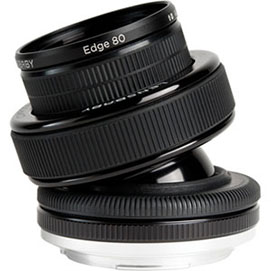

For a long time Lensbaby has created interesting products for photo enthusiasts and portrait/wedding photographers. Even though their products have been used by professionals, some have written them off as "toys". Despite this unfair labeling, what if Lensbaby made something that clearly wasn't a toy? Well now they have and the Lensbaby Edge 80 is the newest product in the Lensbaby line and it is truly a first for them, an optic with true flat field focus. It can be used for "fun" and "creative" shots, but it is clearly the most "serious" product Lensbaby has made to date. I was fortunate enough to have Lensbaby lend me an Edge 80 long before its release today. (In the past I have reviewed most of the Lensbaby lineup including the Sweet 35.) I tested the Edge 80 in a variety of situations that I explain in this review and in a video that we will be posting later today. I have also added my additional thoughts on the optic itself and some image samples. (Note: Generally I don't do much or ANY editing to image samples, but I added some coloring and B/W effects to some of my examples. I felt it was in the "spirit" of Lensbaby products to do so.) Additionally you can be one of the first people to get a hands on experience with the Edge 80 by coming to our special launch event on Thursday the 16th! Enjoy.

Introduction
There is a misconception out there that all Lensbaby products are a inexpensive way to simulate the effects of tilt-shift/perspective control lenses. While the visual result of selective focus can end up looking similar, the science behind the way Lensbaby products work (until now) is much different. While you can spend a lot of time reading about the Scheimpflug principle, film planes, and lens planes, I am going to do my best to explain how the Edge 80 works in Layman's terms. All previous Lensbaby lenses and optics work based on moving a selective "sweet spot" around the frame, meaning a small portion would be in focus, while the rest of the frame would be blurred. The Lensbaby Edge 80 revolutionizes the Lensbaby product line by offering a lens that has a flat field of focus. In simple terms this means that instead of simply moving a "sweet spot" of focus around, you are now able to control a slice of focus that cuts through the entire image. The size, scope, and angle of this slice of focus will depend on what direction you tilt your Lensbaby and how far it is tilted. This is how a true tilt-shift lens works. Again the Edge 80 is not a real replacement for a tilt-shift lens, but $299 sounds a lot more attractive than $1,999 for something that produces a unique special effect. Those who shoot architecture and do serious product photography will still want to get a real tilt-shift lens, but you already know who you are and I don't think I need to digress any further into that.


Construction/Handling
The Edge 80 optic sits well in the Composer Pro, which is the highest quality and most finely tuned lens that Lensbaby has made so far. Just like the Sweet 35, the Edge 80 optic itself is well built and features a built-in aperture ring. Unlike the Sweet 35, the aperture ring on the Edge 80 does not retract into the housing of the Composer when focusing at far distances/infinity. I suppose some will only see this as a small benefit, but I found it to be a tremendous improvement. As you probably guessed, there is no electronic communication between the Edge 80 and your camera, so less light passes through the lens/camera to the viewfinder as you stop down. Therefore, focusing wide open provides for the brightest possible scenario for composition and focusing. This is important because precision focus is vital with a tilt-shift lens. The aperture ring itself is a wide piece of plastic that turns with a slight amount of resistance, stopping with a mild click at each f-stop. The need to pull the front element forward for macro focusing was my one gripe with the Lensbaby Edge 80. This really isn't a big deal, but there is a certain learning curve to using a lens this way. When you want to focus at closer distances, the front element has to physically be pulled forward. To regain infinity focus and the ability to focus further away, the front portion of the lens must be pushed back into place. There are a couple small icons on the lens that show that this has to be done. Before I discovered this, I was quite disappointed with the close focusing capability of the lens, but afterwards I was quite content.

Optics
As you probably guessed, the Edge 80 has a focal length of 80mm. The twelve blade round aperture ranges from f/2.8 wide open and stops down to f/22. While the Edge 80 certainly isn't a macro lens, it focuses close enough for tight portraits. This is a nice portrait length on a full-frame camera, but rather tight/narrow on an APS/crop-sensor camera. Some previous Lensbaby optics showed quite a heavy amount of vignetting on full frame cameras and it was pretty obvious that they designed the products to be used on crop sensor cameras. Quite the opposite is true with the Edge 80. The focal length and coverage of this lens have me convinced that it was actually designed and intended to be used on full frame sensors. It still works quite well on crop sensors, but you just need to adjust your working distance as the angle of view will be narrow. The 12 blade rounded aperture provides for nice "bokeh" or out of focus areas. Unlike some (not all) of the previous Lensbaby optics, the Edge 80 has 5 multicoated glass elements. When extended into "Macro" focusing mode, the minimum focusing distance is about 17", which is pretty darn good for a short-telephoto lens. Most high-end 85mm lenses require you to be almost twice as far away from your subject.


Sharpness
Like all tilt-shift lenses, the sharpness of the Lensbaby Edge 80 relies almost exclusively on paying close attention to where you focus and how much tilt you use. What aperture you shoot at will also impact both the "sharpness" of this lens and the size of the slice of focus. As I mentioned, the optical elements of the Edge 80 are made out of high quality multicoated glass, meaning this isn't your typical Lensbaby from a few years ago. Lensbaby has come a long way with the Sweet 35 and now the Edge 80. Like any other lens in the world it isn't at its sharpest when shot wide open, but it is acceptable. A lot of this has to do with the flat field focus. If you miss your point of focus by just a smidgen when shooting wide open and apply a strong degree of tilt to the lens. The narrow plane of focus will not "slice" through the points that you intended it to. With extreme tilts there seems to be a slight loss in contrast at times, but its nothing than can't be compensated for by boosting contrast and/or "blacks" in post production.


Focusing
Focus is fully manual as there is no AF motor or electronic communication with your DSLR. As I mentioned before the Edge 80 should be focused wide open and stopped down to the appropriate aperture only after focusing. I suppose in the brightest of lighting conditions you can cheat a little bit to speed up your shooting, but don't expect perfect results. The Edge 80 is intended to be used deliberately, not on the fly, but your working speed will increase as you get used to how the optic behaves. Precision of focus will depend on what Lensbaby you decide to use. I would highly recommend not using the Scout or Muse. The Muse itself is a nice invention because it allows for quick focusing and is relatively inexpensive, but its lack of precision makes it a poor match with the Edge 80. The scout is OK if you just want to use the Edge 80 as a straight portraiture lens, but it takes away all the fun of being able to emulate a tilt-shift lens. If you plan to use the Edge 80 out on the streets at all, I highly recommend the Composer Pro because of its flexibility in tilt and focusing. If you plan on working exclusively in the studio, the Control Freak is a nice option as it allows you to lock focus and fine tune the tilt of the lens. Overall there certainly is a learning curve if you haven't used a manual focus lens before. Additionally you will have to learn HOW the lens works when you tilt in different directions.

Conclusion
I suppose the elitists out there who are busy using their 18-way panheads, quadruple XXXX carbon fiber tripods, and $2,000 tilt-shift lenses will still consider the Edge 80 to be a toy. However the Lensbaby Edge 80 is a truly a new optic that should attract many more photographers than previous Lensbaby products have. It can be used as a "toy" to simply create a miniature effect, but you will notice that the out of focus areas will be rendered more like out of focus areas than a typical Lensbaby or any kind of in-camera "miniature effect" setting. Additionally those looking to emulate the effects of a real tilt-shift lens will be pleased. As you've seen in examples here, slices of focus can cut through your scenes at various angles. This can be used for subject isolation, abstraction, or even for product photography as depth of field can be extended in a variety of angles and directions. If you already have a Lensbaby Composer, Composer Pro, or Control Freak, the Edge 80 is a no-brainer. For those who don't already own part of the Lensbaby system, it is a bigger investment to make, but I think it is well worth it if you have any kind of interest in experimenting with selective focus or tilt-shift photography. For me the Edge 80 is very attractive because it can be used effectively for a variety of subjects including portraiture, abstractions, products, and still-life. Something I haven't mentioned yet is the viability of the Edge 80 to be used as a creative tool for videographers. Everything I have mentioned about the Edge 80 also applies to video work. Here is a short clip I did with the Edge 80 to demonstrate how it looks when used for video recording.
Sometimes I don't fully enjoy a product that I have been given to test and I have even been scolded from time to time for being a little bit too harsh/honest, but I truly did enjoy using the Lensbaby Edge 80. I have included a few more additional sample images below. If I haven't convinced you yet, you can check out our exclusive hands-on/demo on Thursday the 16th here at Unique Photo. If you can't make that... Well then you are simply SOL! No I'm only joking, we will be adding the Edge 80 to our Rental program very soon so you can try it before you buy it!
-MZ
More Sample Images


