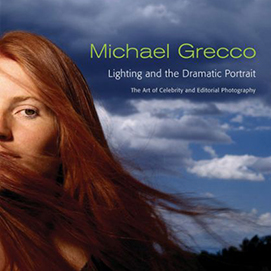
[caption id="attachment_9322" align="alignright" width="278" caption="The Bible for Aspiring Portrait/Editorial Photographers"] [/caption]
In an age when most photography information and education is so centered around what cameras can do and how they work specifically from model to model, it is refreshing to read a photography book that takes a vastly different approach and addresses the bigger issues and strategies that go into creating interesting images. I spoke with celebrity photographer Michael Grecco after reading his e-book "Lighting and the Dramatic Portrait" on my iPad. In this book Grecco stresses style, lighting, collaboration with others on set, etc... which is way more important than blabbing about gear, which is boring. The discussion of cameras in this book is very minimal, which is why I enjoyed it so much. Grecco consistently includes visual examples and some basic diagrams to back up his writing. Many professionals don't like to do this and consider it "sharing secrets", but Grecco doesn't look at it that way. Instead he sees it as educating and sharing knowledge. Keep reading after the break to get my full impressions on "Lighting and the Dramatic Portrait"
Here is a link to Michael's website and a link to his book on iTunes.
Michael Grecco writes with a sense of seriousness and authority, without being overbearing or obnoxious. It is clear that he knows what he is talking about, but at the same time there are enough little jokes and behind the scenes tidbits in there that make this book far more interesting than your typical "How to bounce your flash off the ceiling" type book. Photographers of all experience levels will really enjoy "Lighting and the Dramatic Portrait" and everyone will get something slightly different out of it. I found the insight Grecco gives on composition, posing, communication, collaboration, and creative vision to be far more helpful to the average shooter than any of the details on specific equipment. If you are looking for a nice brief primer on lighting terms, there is a plethora of information for you along with a glossary of lighting/studio terms and slang used on set. Again Grecco just hits the right balance of being informative while maintaining a relatively easy read. I was able to skim the technical/terms section on lighting and still get enough out of it to continue reading further into the book.
 [/caption]
Even if you aren't necessarily interested in becoming a professional celebrity or portrait photographer, "Lighting and the Dramatic Portrait" is a great read, even for beginners. In our conversation Michael made it clear that he wants the book to appeal to a wide range of photographers with varying skill levels. Some of the lighting information may fly right over the head of novices, but the behind the scenes type stories Grecco shares make the book worth reading. There are a multitude of small treasures in "Lighting and the Dramatic Portrait" One of my favorites was when Grecco detailed working with the actor/martial artist Jet Li. Michael needed Jet Li to be airborne in the shot performing some sort of kick, so Grecco highly suggested Jet Li use a trampoline to preserve his energy as several attempts at jumping high in the air would make a normal person tired. Jet Li's people insisted that Jet Li did not need a trampoline. Michael tried persuading them one more time, but in the end Grecco found out that "Jet Li definitely does not need a trampoline."
Throughout the book Grecco recants his own growth as a photographer and while not an autobiography, "Lighting and the Dramatic Portrait" reads almost as if we are learning lighting patterns and techniques as Grecco learned them himself throughout his life. While some may not find this aspect of the book to be particularly interesting, I felt that I could relate to many of the urges Grecco felt as a young photographer seeking to grow his career as a photographer. Grecco's journey from photojournalist to professional celebrity photographer is interesting to follow, but again I want to emphasize that it doesn't dominate the book, it merely adds to the narrative. The most important theme I picked up on is that Michael Grecco is constantly evolving as a photographer/director and that it is one of the biggest reasons for his continued success. This is seen both in his commercial and personal work. Even though MIchael talks about giving up one style, genre, or field of work for another, he mentioned to me that "It is never a final transformation" and that sometimes he will still enjoys using a photojournalistic approach in his work from time to time.
[caption id="attachment_9324" align="alignright" width="225" caption="Grecco learned that indeed Jet Li does not need a trampoline to get serious air"] [/caption]
I was thrilled to see a portrait of Arnold Newman in this book. Newman is one of my favorite photographers of all time and while speaking with Michael, he shared a story of giving a presentation of his slides (yes people used to use slide film in the past) to a group that Newman was a part of. However Newman was unable to attend that meeting and Michael was disappointed. So Grecco contacted Newman personally and asked if he present his work to Newman privately. Arnold Newman obliged and Michael told me that Arnold Newman was "absolutely" a major inspiration to him. This won't be in the book, but the portrait of Arnold Newman is stunning and I thought it was a nice story to share about two incredible portrait photographers.
At the end of the day, "Lighting and the Dramatic Portrait" is really a different approach to the educational photography book. It is a great primer on technical basics, but more so a Bible for those looking to pursue a professional career in portrait photography. Grecco laughed when I told him that I hated most books on photography because of their typically dry and overly technical nature. While perhaps not the best way to start an interview on a photography book, it is indeed true that many photography books are repetitive and filled with mundane technical information. I certainly didn't hate "Lighting and the Dramatic Portrait" and I find myself referencing it quite often for specific information or more importantly to me, general inspiration for my own photography.