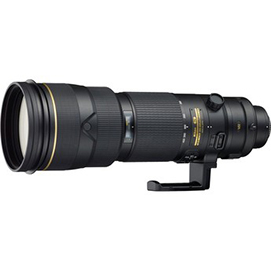
Approximately two years ago, mid-2009, I decided to make the plunge and purchase a long telephoto lens for wildlife photography. I narrowed the choices down to two very quickly: Nikon 200-400mm f4 or the 500mm f4. They each had an advantage over the other but in the end; I purchased the 500mm f4. The deciding factors were the longer focal length and yet still be easy to travel with--even on international flights.

So how am I writing a review of the 200-400mm f4? Recently I had an opportunity to take an Africa photo safari with Roman with Roman Tours in conjunction with Awaken to Africa. This was a dream trip and I wanted to make sure that I had the correct gear for the trip. Three factors helped tremendously in deciding what gear to take. First, my wife, Chris is also a nature photographer. Second, she did not plan on going to Africa. Third, Chris was in need of a longer lens than her Nikon 70-200mm f2.8. These factors meant I could ‘borrow’ some of her gear for the photo safari. I quickly decided on her Nikon D7000 for its 1.5X crop factor to team up with my two full frame Nikon bodies. I already had the 500mm f4 to pair up with the D7000. That gave a nice, effective 750mm f4 set up. The D700 would take a wide angle for landscape and camp shots. That left the D3S and a 70-200mm f2.8. This combo meant that there was a huge gap between 200 and 750mm. Click "More" to read my in depth review, images I shot, and my pros and cons list.
Common sense and some research on the internet indicated that most safari photography would fall into this big gap. That same research indicated that the Nikon 200-400mm f4 lens is a very popular lens for photo safaris. Unique Photo has a lens rental program and the rate for this lens was reasonable for a 3 week rental. However, Chris did need a longer lens for her nature photography. So instead of a rental, we decided to purchase the big lens. Unique Photo did a great job of beating the bushes and locating us a lens. The lens arrived a couple of days before my flight to Africa. (Side note—she was away on business and did not see her new lens until I returned from Africa—it was filthy from all the dust. The first thing I cleaned when getting home was her new pride and joy.) The 200-400mm replaced the 70-200mm on the D3S.
The accessories I use along with this lens are the Gitzo tripod, the Gitzo leveling base, the Wimberly gimble tripod head, a Lowepro Vertex 300 camera backpack, and Andy Bigg’s Gura Gear Kiboko camera backpack.
So how did the big zoom lens do? Wonderfully.
Focus is very fast and on the D3S focus was very fast even in low light. Birds in flight were not an issue to shoot. Even smaller birds could be tracked in flight with sharp focus. The lighter weight of the lens was appreciated over the course of the day and the entire trip. The big zoom lens was almost always the first combo used for any given scene. Having a zoom, even with the fairly narrow range for this lens, was wonderful when a larger mammal moved in close to the vehicle. With the 500mm lens at times I could only do portrait shots. With the zoom lens, I could fit the entire subject in the frame.
[caption id="attachment_5476" align="aligncenter" width="630" caption="D3s 200-400 at 400mm ISO 200 f/7.1 1/320s"] [/caption]
The slightly smaller size and weight made it easy to travel with and even fit in the camera backpack with the large D3S attached. Additionally, shooting off a bean bag was very easy with the lens. One problem with the 200-400mm and a bean bag was the focus ring on the lens. I had to use care to ensure that the focus ring was not resting on the bean bag. If it was and the subject moved, tracking the subject meant the focus ring might move and kick the camera into manual focus versus autofocus. After a few times, it became second nature to make sure that the focus ring was not resting on the bean bag. This did not seem to be an issue with the 500mm. Likely the comfortable resting position did not put the focus ring on the bean bag. The 200-400mm’s lighter weight also meant that this lens was much easier to handhold or to lift into position quickly. That was great for birds in flight or for a running impala.
[caption id="attachment_5473" align="aligncenter" width="630" caption="D3s 200-400 at 400mm ISO 800 f/8 1/1600s"] [/caption]
The 200-400mm lens has a minimum focus distance of approx. 6 feet. There were shots that could be taken with this lens, but not the 500mm prime.
For this trip the 200-400mm became a great landscape lens as photographers cannot leave the vehicle (some nonsense about lions and leopards and…) and the vehicle could not go off road. This meant that to frame a baobob tree with a setting sun required a longer lens than the typical wide angle. The big zoom fit the requirement beautifully.
[caption id="attachment_5477" align="aligncenter" width="630" caption="D3s 200-400 at 400mm ISO 800 f/9 1/250s"] [/caption]
Turns out the 500mm and the 200-400mm were used approx. 50:50 over the entire trip. If I could only take one big lens, I would take the 200-400mm mounted on the D7000 for an effective 300-600mm zoom. The only time you lose out with the slightly shorter focal length are when photographing small birds. For use at home, I still lean towards the 500mm; however, I already plan on borrowing the zoom lens from Chris on a regular basis.
Pros:
- Very fast and accurate focus
- Great images at close to moderated distances
- Lighter and smaller than big primes
- Zoom allows flexibility in composition
- Close minimum focus distance
- Easy to travel with
- Easier to hand hold than big primes
- Fast glass works great in low light or for shallow depth of field
- Can rent this lens for a trial run
- Surprisingly useful as a landscape lens
Cons:
- Pricey for a lens topping out at 400mm
- Heavy enough that many will still find hand holding difficult
- Big primes seem to work better at the longer distances
- Still requires a good steady tripod and gimble mount to get the most out of it
- Hard to find at times - expect a long delay between order and receiving lens
Bottom Line: While I have only had the 200-400mm lens for a short time, it went through a great opening trial. I likely shot about 5,000 images with this lens. It did sunsets/sunrises, birds in flight, landscapes, and a wide assortment of animals all without any issues. The roads are very dusty during the dry season and the lens was cleaned almost daily. It bounced around on the seat of the safari vehicle for over two weeks and not once did it misbehave. Image wise it is as good as the 500mm. The prime lens is better for very small subjects or for those that are located more than about 100 yards away; however, the zoom definitely gets the edge when the subject is close or is very large.
[caption id="attachment_5478" align="aligncenter" width="630" caption="D3s 200-400 at 400mm ISO 6400 f/4 1/125s"] [/caption] [caption id="attachment_5479" align="aligncenter" width="630" caption="D3s 200-400 at 310mm ISO 800 f/8 1/800s"]
 [/caption]