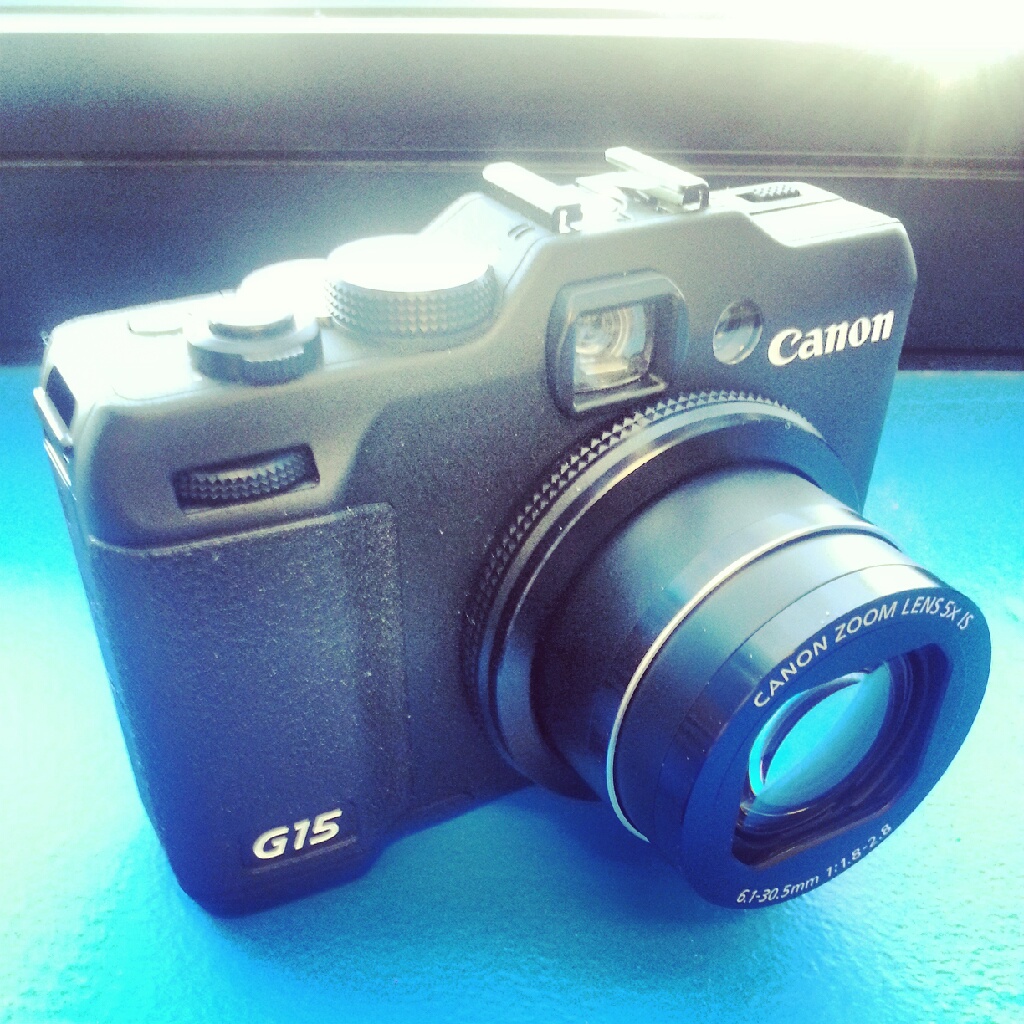
Canon's G-Series PowerShot compact cameras have been renowned for being fast and powerful enthusiast-based cameras. Throughout the years we've seen each new model improve with slight alterations, hoping to cater to the demands of those who want a powerful compact camera. With the long awaited replacement of 2010's G12, Canon might have given us something to be enthusiastic about. The new PowerShot G15 features a 1/1.7" 12MP sensor and high resolution 3" rear screen. True to the G-Series name, it flaunts a boxy style but in a newly-smaller package. The major change is its lens, emphasizing on a fast f/1.8-2.8 lens with optical stabilization along with other performance improvements like quicker auto-focus. Interestingly, they decided to ax the trademark articulated screen and gave its button layout an overhaul to accommodate its smaller size. While Canon hopes that speed will be enough to entice an upgrade from enthusiasts, will the new design be a deal breaker?

Keeping it G The G-series PowerShots have always aimed to be much more than a point-and-shoot. In fact, calling it a typical compact camera would be doing it an injustice. With manual control dials and raw processing, these cameras aren't aimed for the typical Facebook tagger or pet-and-new-baby pic spammer. Instead, these PowerShots are aimed towards the "prosumer"...whatever that means these days. Since the introduction of the G1, these cameras have always featured sensors that were larger than the 1/2.3" sensors inside normal point-and-shoots. The G1 X that was introduced earlier this year was an important step towards competing with DSLR's with its 1.5" sensor with 14.3MP, but it doesn't go without saying that it didn't have its shortcomings. Although the G12 couldn't really compete with such a large sensor, the G-series makes up for that with its faster f/2.8 lenses. Aside from performance, these cameras have always stretched the term "compact". While the G-Series models are generally smaller than a normal DSLR, they are definitely a lot clunkier than the everyday point-and-shoot. This may be a distinguishing quality in a nerdy enthusiast sense, but you'll need generous sized pockets to consider these cameras "pocketable". All of these concerns from the previous models have been taken into account toward the new G15. Fun side note: Canon skipped from 12 to 15 because of superstition. The number 13 is widely thought to bring bad luck, and interestingly enough, the number 4 was avoided because it sounds similar to "death" in Japanese.

Build
Obviously size is going to be factor when you have to house a slightly-bigger sensor with larger optics. The case with most enthusiast cameras is that they are generally chunkier. The G1 X is a perfect example of a big, clunky camera with retro style. Some embrace this, perhaps out of nostalgia of the film days. One thing's for sure: It won't be confused with most consumer point-and-shoots. One practical reason for accepting its heftiness is that they tend to feel more rugged. Feel is a big part of my opinion in just about any camera. I like a camera that doesn't feel "plastic-y" because 1) You're spending all that money, it shouldn't feel like a toy and 2) It gives the illusion that the camera will take more of a beating than normal. The G15 definitely gives a satisfying build-quality. Although a little heavier, it feels more solid in comparison to the G12. In the same, it's not quite the dumbbell that is the G1 X . The buttons, especially the shutter, don't feel mushy or springy like the G12. However, the front dial feels kind of similar to a wind-up disposable camera... OK not that bad, but that was one thing I found to feel a little wonky. In terms of design, It doesn't have the sharper angles of the metal G1 X, but does feel inspired by it. Instead, the G15's aluminum body has a tough exterior with a strangely rough surface. It's not quite sandpaper, but it's enough to make you aware of the texture. I'm assuming this is for additional grip, but I don't think this actually added support. With its slimmer appearance comes a slightly more pocket-friendly camera... unfortunately it left my hand feeling a bit cramped. Although I'd much rather have a more spacious handgrip, it comes down to whether you want a smaller camera or one that gives you arthritis. Also, another major difference from the older models is the lack of articulated screen. I'm sure some who have become accustomed to using a viewfinder for gaining creative angles and general narcissism might miss this feature, but it's a major reason behind the thinness of the camera. Besides the larger LCD, the back buttons remain pretty much unchanged. The top, however, features a much different dial layout. One thing missing is an ISO dial. Instead they've moved the exposure compensation and stacked the mode dial on top. While looking swift, it is a trade off for one less dial that you might find yourself missing.

Operation
Start up is quick, which is pretty much standard (or at least should be). The menus are fairly straightforward and easy to navigate. You use the back scroll wheel to choose aperture and the front wheel to choose shutter speed. It takes some getting used to, but if you plan on using this camera on manual settings its worth the fifteen seconds of acclimation. Otherwise, it doesn't take a PHD to use it as a normal point and shoot. Composing in the digital era has become a lot about "jazz hands", or using the LCD to stake out your shot. While it's nice that Canon continues to offer a viewfinder on a camera like this (probably from fear of pissing off their traditional enthusiasts), I wonder how many people will actually compose with such a small port hole. Not unlike a Rangefinder type camera, you can see the lens at your widest focal length. It zooms well with the lens, but again I don't see it practical when it doesn't have a meter inside. As long as it's not another crappy electronic viewfinder, I'm very much fine with that.
Luckily for the live-viewers, the screen has been improved in both size and resolution. Even in the bright sunlight I wasn't blinded by iris-scorching glare. To be honest, I'd rather have a screen that I can see, rather than one that does triple-axles and will probably snap off one day, but that's just me. The pop-up style flash is pretty much standardly so-so. Even at further distances, I found it would over-compensate, so I'd be dialing down. On-camera flash is always a nice gesture, but it can hinder more often that help in most situations. If artificial lighting is your thing they still have a handy-dandy hotshoe, which would probably fair you better.
Now onto optics: The G15's lens is really the selling-point of this camera. The focal length remains the same as the G12, but at f/1.8 this guy doesn't disappoint in low light situations. It's also pretty handy for that sought-after bokeh that makes people think you're a professional. Even zoomed in, its maximum aperture is 2.8, which was the widest aperture on the older models. Also improved are the autofocus and image stabilization. It has the same amount of focus points, but I noticed the AF to be much more swift. Speaking about the need for speed, there's a feature for 2.1 fps shutter burst with its High-Speed Burst HQ mode. This can shoot a maximum of 10 frames and can take on just a single burst. Lastly, I noted how well the battery life was. With on and off shooting for two days I didn't really drain the battery. They have it rated for 350 shots which seems like a pretty good standard.

Image Quality
Before using the G15 I was pretty certain that they were just jamming more pixels onto a slightly larger sensor. My presumption was that image quality would be comparable to any APS sensor until you start cranking the ISO. To my surprise I was pretty impressed with how the little(ish) guy performed in any condition. I took it to the annual Mushroom Festival (of all things) in Morristown, NJ to see how well it would do both indoors and out. Although most of my pictures ended up being of the many wizard beards at the convention, I tried my hand at putting the close focusing to work. Amazingly, it can focus as close to 1cm. Shooting wide open at such a short distance, you do gain the nice out of focus smoothness in the background. Images in macro we're very sharp, the colors lush, and even though the pictures I took from the gardens really screamed boring stock imagery, they honestly looked pretty good.
Ample amount of ambient light really isn't much of a challenge for this camera so I decided to take it out at night to see how it would fair in the dark. Pushing the ISO up to 1600 yielded less noisy images than I expected. The ISO range is 80-3200 (expandable to 12800). Towards the latter, images suffer from noise issues, but that's not unexpected. When testing out the ISO at night, I didn't let my lack of tripod stop me. Thanks to the image stabilization I got a few that didn't look like they were taken with beer-goggles on. Image shake can be a real pain when you're handheld, but the image stabilization proved to be pretty nifty with my shaky grip and slower shutter speeds.
A new feature in this camera is 1080p HD video, which seems to be making its way into a standard for just about anything with a camera. Well, if you need it, it's here. This is usually the last on anyone's radar, but sound quality was actually really crisp. One video feature that wins me over is the super slow mo at 240fps. The possibilities of watching your friends fall down in slow motion are endless. Lastly, as with the previous models, it can capture RAW files. I'm sure it would make this annoying guy smitten. RAW shooting has always set it aside from normal point and shooters, as it furthers the user to gain full potential of their images. Even RAW capability, like HD video, is becoming a no-brainer on smaller systems. Overall, considering it's sensor is much smaller than that of most DSLR's, it compares surprisingly well in terms of image quality. For more test images check out this flickr set.

Final Thoughts I fully welcome a camera that encourages users to shoot manually. Judging from older models with just a single scrolling wheel for exposure settings, I would have laughed if I even thought about shooting manual with a point-and-shoot. The additional controls work well to let you have full control... but is an enthusiast camera like this just a DSLR-Lite? There's merit to having a smaller system with great image quality, but you're still limiting yourself from the full range of control. Even in terms of size, it's great that they're trying to make this camera more pocket-friendly, but it still has some ways to go. Comfort should come before looks.
I don't think this camera would be suited for the everyday person who doesn't know the basics of photography. It would be kind of a waste for them anyway. Those who would be interested in this camera might be advanced users who want a compact system, maybe for the not-so-average vacation, who knows? An enthusiast would enjoy the benefits of shooting on manual without having to lug around all the extra weight of a DSLR. The major question is whether or not one would want to trade up for a faster lens with the exclusion of a vari-angle display. Judging from the images I took, I'd definitely consider it. Unfortunately, the ergonomics of the G15 keeps me from saying it's a definite buy. With the point-and-shoot market already feeling the pressure to conform to customers interest in touch screen this or that, is it a smart move to mess with a formula that works? While I'm sure the idea of creating the perfect compact camera is on the minds of many manufacturers, will people even care by the time they get it right?