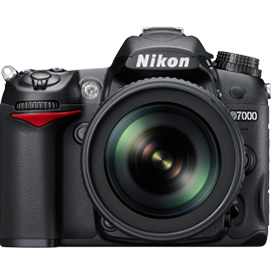
[caption id="attachment_1958" align="alignright" width="180" caption="The New Nikon D7000"] [/caption]
This past weekend I was supposed to going on vacation, but when we got one of the new Nikon D7000 kits for our display case I couldn't resist taking it along with me, to test it out. The D7000, along with the Canon 60D were two of the most highly anticipated cameras this past summer. Whenever either Canon or Nikon is expected to release a new camera, there is usually buzz, especially the higher-end models. The problem is most people talking about them online will never actually buy a D3 or 1D to use. The D7000 is a camera many people are interested in because there are many more enthusiasts or aspiring photographers willing to spend $1,200 than $5,000 on a camera body. Additionally the D7000's predecessor, the Nikon D90, was one of the most successful cameras in this advanced amateur category. In fact it's my opinion that even though the D7000 boasts some great new features, the D90 is still a capable workhorse, and is still one of the best values in the current DSLR market! So with the perfect storm of hype leading up to the release of the D7000, I wanted to find out if it would live up to expectations. Keep reading after the jump/break to find out if it did!
Here are the links to our store site for the body and kit. Both the kit and body are back-ordered, but the sooner your order, the sooner you'll get your camera!
Introduction - Handling and Controls
The D7000 boasts many impressive features on it's spec sheet. For the whole list, here is a link to Nikon's official website. It will contain all of the technical information you need to know about the camera. When I first took hold of the D7000, I was a little bit surprised. Based on all of the hoopla I had read online, I expected it to actually be a little bit bigger. Some people online even speculated that the D7000 would be almost as big/heavy as the D300s, but this isn't the case. The D7000 is closer in size to the old D70 and D70s cameras that many of us Nikon shooters had as our first DSLR. The D7000 is slightly taller than the D90 and certainly has a little bit more weight to it because of its semi-magnesium-alloy chassis. Overall, the camera feels comfortable to hold and well balanced, just like every other Nikon I've shot with in the past. The 18-105mm VR kit lens is a good enough lens to start with, but I preferred using my 24-70 f/2.8G. A 17-55mm f/2.8G DX lens would have been ideal, but when I wanted a wider angle of view I just switched to the 14-24mm f/2.8G. Even with these heavier lenses the D7000 felt well balanced because of it's size. The only complaint I had was that the camera seemed a little bit slippery on the front part. The rubber material Nikon uses on their higher-end cameras gives a much more reassuring feel when holding the cameras.
[caption id="attachment_2045" align="aligncenter" width="300" caption="Taken in the later afternoon after some rain with the D7000 and 18-105mm lens in Kennebunk, Maine"] [/caption]
New Buttons and Dials
The Live View Switch from the lower-end D3100 has made its way onto the D7000. With the flick of a switch you can switch to Live View/Video shooting. The little red button in the middle will start/stop video recording. The Live View functionality of the D7000 (and the D3100) is much improved from previous Nikon DSLR cameras. My only complaint about this switch/level is that I bumped it a few times with the palm of my hand while shooting stills and was startled when the viewfinder suddenly blacked out. Oh well, no big deal, I'm kind of clumsy to start with, this shouldn't be a problem for many people. Although in the future I think Nikon should put a lock on this switch to avoid this type of issue.
[caption id="attachment_1961" align="aligncenter" width="239" caption="The Same Live View Switch from the D3100 is featured on the D7000"] [/caption]
In addition to the all new MULTI-CAM 4800 AF system (which I will talk about more later), Nikon also added a button on the side of the camera. The AF/M switch changes back and forth between auto and manual focus modes. This is pretty standard on all Nikon cameras, but now pressing a button in the middle of the switch will allow you to change different AF options with the main and sub command dials on the front and back of the camera. The different AF area modes are single, dynamic, and auto. Rotating the main command dial allows you to switch between AF-S (Single), AF-C (Continuous), or AF-A (Auto).
[caption id="attachment_1981" align="aligncenter" width="265" caption="Pressing the button on the AF/M switch and turning the sub-command dial will change the AF "Area Mode""] [/caption]
Nikon took a wise page out of Canon's book and also added two customizable user setting modes to the top mode dial of the camera. This is perfect for when you are shooting both in and outdoors. For example you can set "U1" low ISO, daylight white balance with a vivid picture control. Then you can set "U2" to a high ISO, tungsten white balance, with a neutral picture control setting. Doing this will make shooting indoors and outdoors a breeze. Granted you may have to tweak some settings, but it is so much easier than having to be constantly changing all of your settings.
[caption id="attachment_1986" align="aligncenter" width="268" caption="The Mode & Release Mode Dial"] [/caption] [caption id="attachment_1987" align="aligncenter" width="161" caption="A graphic from Nikon's DigiTutor"]
 [/caption]
Nikon also decided to include an element from their higher end cameras. The mode dial on the D7000 has the traditional "Release Mode" dial of the D300/700/3 cameras. This allows a user to quickly switch between Single, Continuous Low, Continuous High, Quiet, Self Timer, Remote, and Mirror Lock-Up Mode. This is refreshing and shows that Nikon is committed to releasing "photographer-oriented" products. Making a camera easier/faster to use for photographers is important to me. A bunch of throw in garbage features like "In Camera HDR" don't mean anything for real photographers and I am glad Nikon has steered away from that. It is clear over the next several years that certain companies are going to take much of the consumer market away from both Canon and Nikon, who dominate every segment of the photography market right now. However I hope that both Canon and Nikon will not buck the trend of being committed to photographers who like well-designed mechanical cameras, not pathetic plastic toys with lenses on them! For the consumer market, gadgetry, unergonomic small size, and gimmicks such as "3D" are fine, people like those things, but photographers find them annoying and pointless. Sorry about the little tangent, but it's an interesting phenomenon that is happening at a fairly rapid pace.
What Else is New?
The popular electronic level that can be found in many DSLRs is in the D7000. It's pretty much a standard now in all modern higher-end DSLR cameras. The D7000 features an IR sensor on both the back and front of the D7000 so using an infrared remote trigger should be a lot easier. I don't know why manufacturers hadn't thought of this before, but this should solve at least some problems photographers have using IR triggers/remotes.
[caption id="attachment_1992" align="aligncenter" width="300" caption="The D7000 features a virtual horizon that helps you level the camera for both yaw and tilt."] [/caption]
Over the course of my trip I shot RAW + JPEG so I could compare the output from both. I quickly filled up a 4GB SD card and then worked on an 8GB card. The best part is I didn't have to change cards! The D7000 is the first DSLR to offer dual SD media slots. Some more expensive DSLRs have dual CD or CF/SD slots, but I expect this to become a norm in most mid-range DSLRs within the next year or so. Increasing sensor resolution and adding in video means more memory is needed. Like other Nikon DSLRs you can set the 2nd card slot to be overflow, duplicate the first card, record video only, or record the JPEGs when shooting RAW + JPEG. To me the last option is somewhat of a waste. When I upload my pictures I sort by type and move them into two different folders, but to each his/her own.
[caption id="attachment_1993" align="aligncenter" width="300" caption="The D7000 is the first DSLR to use dual SD media slots"] [/caption]
As someone who has shot thousands upon thousands of frames with a D700/3, I am used to an advanced and fast autofocus system in DSLR cameras. The blazing fact and deadly accurate MULTI-CAM 3500 system in the D700/3 works so well in the dark and nails focus almost every time. So when using a camera I am unfamiliar with, I am always a hard judge. Nikon created an entirely new 39-Point autofocus system, MULTI-CAM 4800, for the D7000. Based on the brief weekend I had with the D7000. I can already tell that the AF system is worlds better than any other camera at this price point. Many potential buyers may not take advantage of all of the AF features in the D7000, but for those who are looking to photograph sports or moving subjects on a budget will be very satisfied with the dense positioning of the 39 AF points and 3D tracking mode. The speed and accuracy are slightly better than the D300s because of the new EXPEED2 processor in the D7000. The difference is subtle, but there is definitely a little bit more "snap" when focusing, especially with one of the 9 cross type sensors. The D7000's frame rate tops out at a relatively quick six frames per second, only one less than the more expensive D300s. For most photographers this should be more than enough speed. The advanced new AF system also makes the D7000 a good sports photography camera.
[caption id="attachment_1975" align="aligncenter" width="300" caption="All 39 Points of the D7000's MULTI-CAM 4800 AF system"] [/caption] [caption id="attachment_1976" align="aligncenter" width="300" caption="Having 39 AF points makes using fast aperture lenses easy. You can pick exactly where you want to focus without recomposing. This clock was shot with the Nikon 50mm f/1.4G at f/2."]
 [/caption]
The 100% Viewfinder is perhaps the most underrated and overlooked feature of the D7000. If you've shot both DX and FX cameras (or larger Medium Format), you know that looking through a viewfinder of a DX camera leaves a lot to be desired. Although you may not realize it, when you look through the viewfinder of almost any other DX camera you are not seeing 100% of what you are photographing. Most DX cameras have a 95 or 96% viewfinder. For most applications this doesn't mean a whole lot, but for those using ultra-wide angle lenses, this does make a big difference. With the D7000, when you frame/compose your shot, what you see in the viewfinder is really what you'll get. With most other DX cameras, what you see is not what you actually get. There is actually a little bit more room around the edges. A little cropping can fix this, but for people who like to get their images "right" out of camera, this will save you time. Additionally because of it's larger size, the actual area/frame looks slightly larger. Right now the Canon 7D is the only other APS-C camera to boast a 100% viewfinder.
[caption id="attachment_2038" align="aligncenter" width="300" caption="The Pentaprism for the D7000"] [/caption]
Image Quality
The increase to 16 Megapixels is a logical one to keep stride with the demands from the consumer market. It's only 4 more than the D90, so you won't notice a huge difference, but have a little bit more detail to crop with. I'm all for increasing Megapixels if it doesn't impact high ISO performance. It seems that Nikon has achieved this. The D7000 RAW files that I processed in Lightroom 3 looked great and I will share some of them later. JPEG quality was nice, but as usual, you need to shoot RAW with the D7000 to get the best results. Some cameras like the Olympus E-PL1 break this trend and have incredible JPEG engines, but it is uncommon. If you want to shoot JPEGs for convenience you can tweak your sharpening, contrast, and color settings more using picture style settings such as vivid, neutral, etc... In terms of noise, I found the D7000 to be very similar to the D90, D5000, and D300s. Some people may be scratching their heads, but don't forget Nikon also increased the resolution of the camera. Although the noise levels look similar to the D90, you're getting higher resolution files as well. Overall the high ISO shots probably look a little cleaner and sharper than D90 files, but I think the fact that I'm using Lightroom 3.2 is a factor. From my experience so far, the Noise Reduction and overall RAW processing of files in Lightroom 3 seems superior to anything else I've used in the past. I'll say this, ISO 3200 looks super clean. Here is a sample. Remember that the 100% crops are very magnified and represent what you would see if you were looking at a massive print, several feet wide. For normal size prints ISO3200 is very usable on the D7000.
[caption id="attachment_1964" align="aligncenter" width="300" caption="A frog in an antique shop in Wells, Maine"] [/caption] [caption id="attachment_1965" align="aligncenter" width="300" caption="100% crop of above image. Default NR in Lightroom 3"]
 [/caption] [caption id="attachment_1966" align="aligncenter" width="300" caption="100% crop of above image with some more NR added in Lightroom 3"]
 [/caption]
Conclusion
Overall the D7000 lived up to the hype. It's everything that it's supposed to be, the most feature rich camera for photographers in it's class. A lot of people have compared it to the Canon 60D and noted the D7000 has slightly better specs. However I consider it to be a wash, if you're a Nikon shooter looking to upgrade from an older body, go with a D7000. If you're a Canon shooter looking to the same, the 60D is the camera for you. Neither one is significantly better at anything to justify a system switch, that's why I didn't bother doing a head to head review. That being said, the choice for Nikon shooters with a D90 is a little trickier. As I mentioned before, the D7000 is only a slight upgrade in image quality over the D90. A new lens or flash(es) may be in order for you instead. Don't forget just because something is new doesn't mean you need it to take good photographs. The D90 was a tremendous upgrade from the D80. At ISO 3200 the D90 produces results that came out of the D80 at ISO 800. That's a tremendous two stop leap in image quality. You won't see the same difference between the D90 and the D7000, the technology just isn't there yet. However the D7000 does offer some nice new features and those of you with D70, D80, or even D200s, should seriously be considering the D7000. Let's not forget video functionality either. I only had this camera for a weekend and I am not a videographer, so it would be unfair for me to make a judgment on the video, but it is 1080p HD quality with full manual controls, something Nikon shooters with video aspirations have been asking for.
[caption id="attachment_2044" align="aligncenter" width="345" caption="A shot made very early in the morning with the D7000 and 18-105mm lens on a cloudy day in Kennebunkport, Maine."] [/caption]
So you may be wondering why I bothered to take the D7000 out for review if I was going to conclude "you don't really need it". The simple answer is that this was a very highly anticipated product and I wanted to see if it lived up to expectations. It did and for some people out there it's a very logical choice. My intention is always to steer people towards the gear that will help them make better photographs. If you own an older Nikon SLR and don't need something quite as heavy and/or advanced as a D300s or D700, the D7000 is perfect for you. For now the D7000 is Nikon's newest and most innovative SLR, which has a feature set from higher-end SLRs. This is a camera for real photographers and serious enthusiasts. You won't see any touch-screens or gimmicks here, just good old-fashioned high performance hardware.
More Sample Images
[caption id="attachment_2050" align="aligncenter" width="300" caption="18mm 1/50s f/5.6 ISO 400"] [/caption] [caption id="attachment_2051" align="aligncenter" width="300" caption="105mm 1.6s (tripod) f/11 ISO 100"]
 [/caption] [caption id="attachment_2053" align="aligncenter" width="300" caption="75mm 1/200s f/5.6 ISO 800"]
 [/caption] [caption id="attachment_2054" align="aligncenter" width="300" caption="26mm 1/320s f/5.6 ISO 320"]
 [/caption] [caption id="attachment_2056" align="aligncenter" width="300" caption="14mm 1/80s f/3.5 ISO 800"]
 [/caption] [caption id="attachment_2057" align="aligncenter" width="198" caption="24mm 1/100s f/3.5 ISO 400"]
 [/caption]