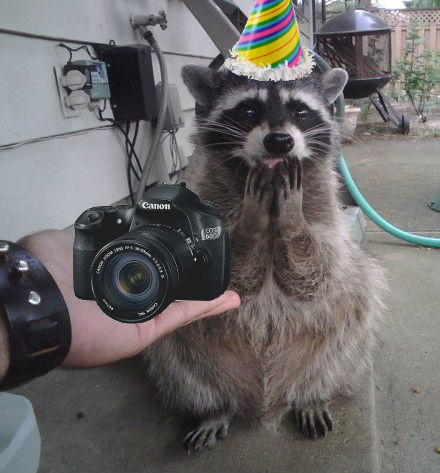

For me?!?
Gifting can be a tricky thing and good intentions might bring forth some mixed feelings. Maybe your hubby went all out and bought you an expensive camera that you casually brought up one day. He or she knew you had some kind of interest in photography and now you own a fancy DSLR which seems daunting, albeit exciting. You hastily mash the battery and memory card into the camera just to see the first picture you take is a dark, blurry, David Bowie-esque depiction of the world around you. Discouraged, you put the camera down and think, "maybe this isn't for me..." Before you start to think about returning your new DSLR for something useless like a coach bag or limited edition Jordans that you're never going to wear, first think about the twelve days of incessant Googling, Amazon customer review prodding, and Youtube unboxing that your true love gave to thee. Then think about the fact that you actually do have interest in photography...and I don't want to hear any of that "I'm not much of a photographer..." hullabaloo. You have at least 30 days to figure out if you want to abandon ship, so why not give it the ol' college try?
1. Green means go right?...
Everyone knocks auto mode and there's merit to that, but it shouldn't deter you from taking pictures altogether. This might be blasphemous, but go ahead...shoot on auto mode. I assure you this is just tough love. You're going to see how quickly things start to feel like a big point and shoot. Don't get discouraged. Just know you can take BETTER pictures once you know how to piece together the puzzle. Although no one expects you to try and tame the wild horse that is manual mode within seconds of owning a DSLR, you can take baby steps. Steps include learning. I know, no one said anything about learning.

To auto, or not to auto? That is the question.
2. Get Schooled
You could try to read the camera's user guide from front to back, but it still won't go over principles of photography. Learning exposure is the first hurtle in any budding photographer's journey. Understanding the relationship between shutter speed, aperture and ISO is something that goes a long way and can be applied to any camera. Luckily for you, the internet is one vast resource of information and if reading isn't your thing, there's a ton of helpful videos online. Even more beneficial is having a real live teacher show you the ropes. Take a one-off photography course at any community college, or even more convenient at Unique University. Chances are you'll have a lot of questions, and who better to ask than our talented instructors who have years of professional experience and are glad to go the extra mile to help you understand the essentials.
3. Make Mistakes
With a basic understanding of how a camera works, you can now safely escape auto mode. Note that you're still going to make mistakes, but this is all part of the learning experience. Just be thankful you're not wasting film and remember that there can be beauty in those happy mistakes...The trick is eventually learning how to do them intentionally. There's going to be times when you look at the camera and wonder what all these funny looking buttons do. For now, don't fret over it. Stick to the basic controls until you're ready. Even on aperture and shutter priority you can gain a sense of what adjusting a setting can do. Through practice it will start to make sense. Repetition is really the only way to effectively learn anything. This involves bringing your camera everywhere. It might seem annoying at first (for the people around you) but in the same you're learning how to train your eye for what works and what doesn't.
4. Create Reasonable Goals

Thanks to the internet, these people are having 100% more fun with photography.
With your interest in photography comes the urge to simulate photos that others have made. Like I said before, the internet will be your best friend. There are a mind-numbing amount of tutorials on specific types of photography that can help you get to where you're going, but again you're going to need a little understanding on the terminology. It's very easy to get lost in dense calculations of effective focal lengths vs depth of field, evaluative metering vs spot metering, the differences between sensors on extremely wordy blogs (...) That's the funny thing, anyone can learn photography, but keeping up with the rest of the overly technical world can be a challenge.
5. Have Fun?
I stand by my belief that the best way to learn is by doing. Taking a class helps you understand what you're doing and those with experience can help you achieve those pictures you want to recreate. Most importantly the one tip I rarely see on any blog is to have fun. You're never going to have as much unadulterated fun as that moment when you were first handed a camera. Everything after that is an attempt to emulate the fun you had when you didn't know what you were doing ;-) The best advice I can give you is to keep your expectations reasonable and just keep shooting to your hearts content.