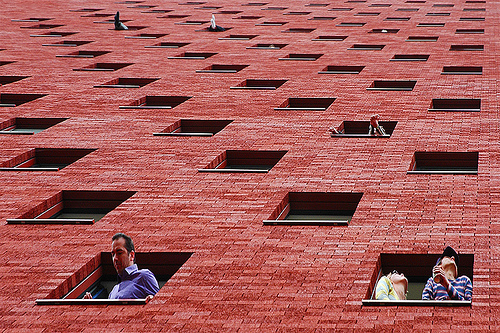
August 19, 2014, World Photography Day, will be celebrated as the 175th year of photography. It marks the 175th anniversary of the first permanent photographic process that was patented and freely released to the world on August 19, 1839.
On the eve of World Photography Day, internationally celebrated by the photographer fraternity, Unique Photo gives you a little insight in things that make possible a good photograph.
If you have a passion for photography and are considering digital photography classes, here are some tips on composition for beginners and all photography enthusiasts. Knowing these rules will give you a solid foundation.
1. Think that your frame is divided by 2 vertical and 2 horizontal lines, making 9 equal segments. According to the rule of thirds, place your subject or most relevant element of your scene along those lines, or at a point where the lines intersect. This not only balances the photo but also adds interest.

Image courtesy: Grant McDonald
2. Following the rules of thirds makes the photo interesting but at times, it can also create a void and make the scene feel empty. This is why you need to balance your subject’s “weight”. Include another element of lesser significance to fill the void.
3. Look for leading lines. These are the lines that naturally draw the eyes into the photo. Lines can be diagonal, straight, zigzag, radial or even curvy. Any line that leads toward the subject, portrays a journey or simply pulls the eye into the picture takes an image up a notch.
4. Symmetry and patterns are all around us—whether man made or natural. Look for patterns and symmetry to make catchy compositions. You can also break a pattern or symmetry by adding a focal point and tension to the scene.
5. Figure out the view point before you shoot a subject. Where you shoot the subject from affects the composition significantly and the message that your image conveys depends on it. Think of more ways to photograph a subject besides eye level. Think of shooting your subject from the ground, or from a high point, from the back or side, up close or from a long distance away.
6. While your eye might excellently view a scene and all the elements in it, the camera, more often than not, tends to flatten the background and foreground, thereby ruining a photo. So always compose your shot in such a manner that your subject is against a plain background and there is nothing to distract from it.
7. Since we shoot photos in 2D, we need to compose shots in a way that portrays the actual depth of a scene. This can be achieved by including objects in the background, middle ground, and foreground. Another way to show depth of field is by using the overlapping technique, in which you can obscure an object partially with another object. When there are multiple layers, the eye can recognize them and separate the layers to perceive depth in the image.

Courtesy of Actionlovr
8. All around you, you will find objects, such as archways, trees, holes, et al, that are great for natural framing. When you place such an object around your composition’s edge, the primary subject is isolated from the outside world, thereby creating a focused image. This helps the human eye to naturally focus on the main point of interest.
9. Cropping has to be done smartly. If your subject is extremely small, it will be lost amid the other elements in its surroundings, and the photo will have little or no impact. You need to crop tight around the main subject and get rid of any background noise. Always make sure the viewer’s eye is drawn to the subject with undivided attention.
10. Any digital-photography class will tell how the art of photography has come a long way, from the analog times of film processing to the current digital age. Now that no one has to worry about the cost of films, there is a lot of room for experimentation. You can always shoot as many photos as you want, and simply delete the unwanted ones, thereby giving you a lot of freedom to experiment with composition. Practice the tips stated here, and see the magic for yourself.
We hope the things we suggested in this article will help you make your next shoot better. If you like the article, please don't hesitate to share it with your friends.
Also Read: 10 most common photo editing mistakes