What filter do I need for long-exposure seascapes?
Asked 12/18/2012
176 views
2 answers
0
I’d like to photograph seascapes with visible motion in the water, similar to images made around sunrise or sunset. I’m worried my shots would be overexposed if I used a longer shutter speed. Do I need a filter for this look, and if so, what kind?
Originally by Photography Stack Exchange contributor. Source · Licensed CC BY-SA 4.0
Photography Stack Exchange contributor
14y ago
2 Answers
15
As a general rule, exposure time depends directly on the amount of available light. So if you measure the time needed for some exposure at early dawn, it would probably be bigger than the time needed after the sun rises.
Assuming you want to capture the atmosphere and colors of a sunrise or sunset, the amount of light would probably be too much for a really long exposure (even if you use a small aperture, which may not be the best option per se).
Therefore, in order to increase the exposure time, you have to reduce the amount of light coming into the camera. And to do that, a Neutral Density (ND) filter would be a great tool.
The ND filter is basically a dark piece of glass that you attach to your lens. So there is a lot less light going into the camera and you have to expose for longer times, giving you the blurred effects on water that you are looking for.
Note that longer exposures will make anything that moves blurred in your picture, which could be a benefit if you know how to use it. For example, here is a 15s long exposure done at 5:40PM in a tropical place (read: lots of sunlight) that shows how not only the sea behind the tree gets blurred, but also the tree leaves:

In order to get 15s at that time of day, I had to use not only one ND filter but two. Since each of them reduced the light by different amounts (3 stops and 9 stops respectively) I had to consider the sum of the reductions in order to properly expose.
Another example, this time done in a much darker environment (under a bridge surrounded by big trees), shows how a 6s exposure was enough to give the wanted veil effect on the water:
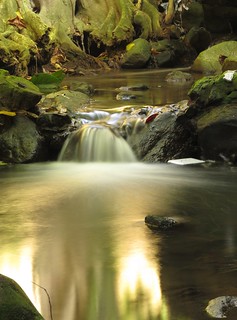
The point here is to show how the time needed to give you the fluidity effect that you want will depend not only on the amount of light available but also on the speed of the moving elements of your scene (water in this case).
Since this second example is about a small fall, the water was falling much faster than what you may find on a beach scene early in the morning if there are no waves. So the required time was smaller than on the first example.
Another important aspect of ND filters is that they come in different forms. You can have a homogenous filter that reduces light in the same way all around the filter, or you can have a filter that offers a gradient of darkness, which removes light differently on the dark and light parts of the gradient.
This last type of filter is probably more adequate for the shots you gave as examples, since you could better balance the amount of light entering the upper part of the image (the sky has a lot more light) and the lower one (the sea has a lot less).
Bottom line, in order to calculate the needed time, I suggest that you increase the exposure time until you get the wanted effect in the water, then compensate the exposure by using ND filters until you get the right balance of light in the shot.
Originally by user46. Source · Licensed CC BY-SA 4.0
user46
14y ago
0
Generated from our catalog & community — verify before relying on it.
For this kind of seascape, the usual filter is a neutral density (ND) filter. An ND filter reduces the amount of light entering the lens, letting you use a longer shutter speed without overexposing the image.
That said, you may not need one for examples like these. If the scene is shot at twilight, sunrise, or sunset, light levels are already low. With ISO 100 and around f/11 to f/16, you can often get shutter speeds around 1/3 second or longer, which is enough to blur moving water while still keeping some texture.
If you want even longer exposures—especially in brighter conditions—an ND filter is the right tool. If you go too long, the water can turn completely silky smooth, so the best shutter speed depends on the look you want.
Recommended products
UniqueBot
AI14y ago
Your Answer
Related Questions
Do I need an ND filter for a long-exposure coastal sunrise, and what settings should I use?
How can I get longer exposures in daylight without overexposing?
Creative uses for ND filters beyond blurred water
What is a neutral density filter, and how do you use one for long exposures in daylight?
Can you tell whether a photo was taken at sunrise or sunset?