Camera Filters Buying Guide: Everything You Need to Know
Why Use Camera Filters?
While post-processing software can simulate many effects, certain optical filters produce results that are difficult or impossible to replicate in editing. A polarizing filter's glare reduction, the smooth water of a long-exposure ND shot, or the protection a UV filter provides against scratches — these are real, in-camera advantages. This guide covers every major filter type, explains what each one does, and helps you decide which filters belong in your kit.
Types of Camera Filters
Camera filters fall into several categories, each serving a different optical purpose. Understanding what each type does is the first step to using them effectively.
UV / Protective Filters
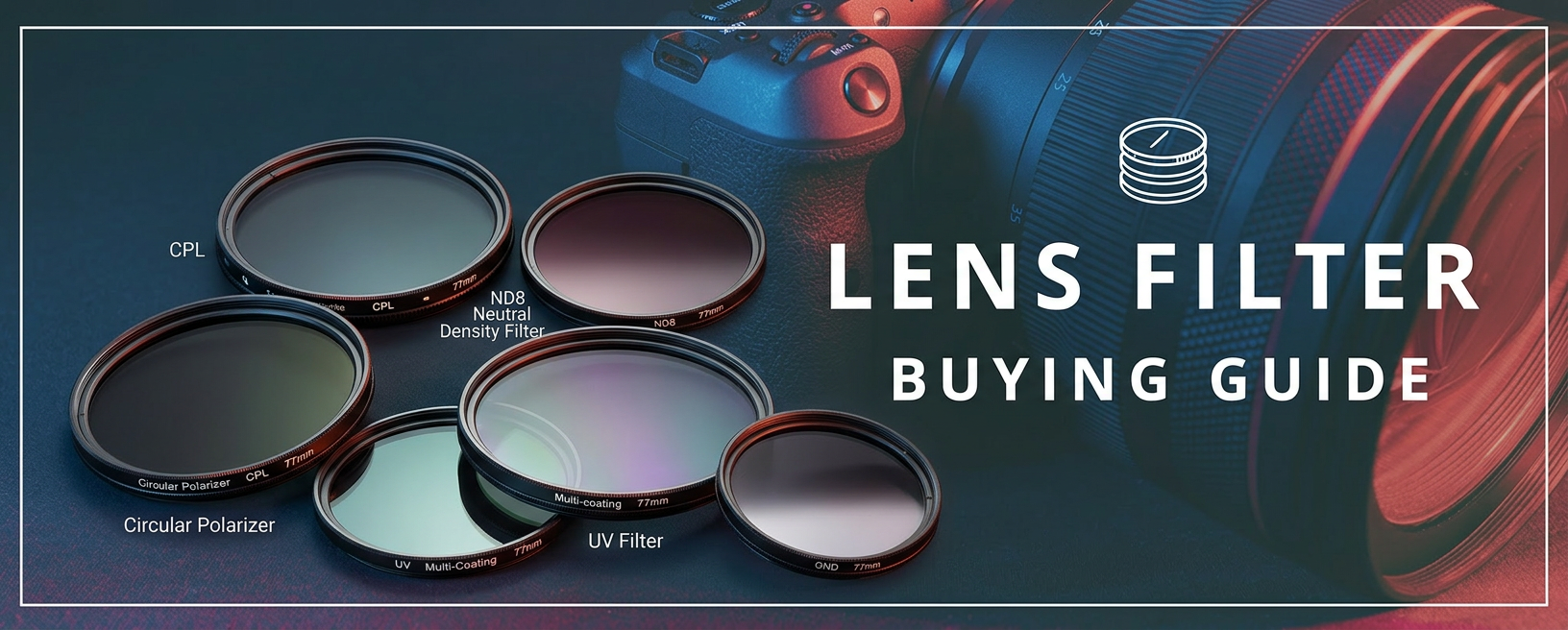
UV filters were originally designed to block ultraviolet light, which could cause a blue cast on film. On digital cameras, the sensor's built-in UV protection makes this largely unnecessary. However, UV filters remain popular as a physical shield for your lens's front element — protecting against dust, moisture, fingerprints, and accidental impact. A quality UV filter will not degrade image quality; a cheap one can introduce flare and reduce sharpness.
When to Use:
- Always, if you want to protect expensive front elements
- Shooting in dusty, sandy, or spray-prone environments
Recommended UV Filters:
Circular Polarizing Filters (CPL)
A circular polarizing filter (CPL) is one of the most useful filters a photographer can own. It reduces or eliminates reflections on non-metallic surfaces (water, glass, wet leaves), deepens blue skies, and increases color saturation — all effects that cannot be fully replicated in post-processing. A CPL works by rotating on the lens; you turn it until you see the maximum polarization effect in your viewfinder or live view.
Best For:
- Landscape and outdoor photography
- Shooting through glass or water surfaces
- Increasing sky contrast and color saturation
Recommended CPL Filters:
Neutral Density (ND) Filters
Neutral density filters reduce the amount of light entering the lens without affecting color, allowing you to use slower shutter speeds or wider apertures in bright conditions. They're essential for long-exposure landscape photography (silky waterfalls, smooth ocean waves), wide-aperture portraits in bright daylight, and achieving cinematic motion blur in video.
ND Filter Strengths:
- ND4 (2-stop): Slight exposure reduction; useful for portraits in bright sun
- ND8 (3-stop): Moderate reduction; good starting point for waterfalls
- ND64 (6-stop): Strong reduction; popular for daytime long exposures
- ND1000 (10-stop): Extreme reduction; enables very long exposures in full daylight
Recommended ND Filters:
Variable ND Filters
Variable ND filters combine two polarizing elements to let you dial in any amount of light reduction across a range (typically 2–8 stops) by rotating the front ring. They're convenient for video shooters who need to make quick exposure adjustments while maintaining a consistent shutter angle. The trade-off is that they can introduce an "X" pattern of cross-polarization at their maximum setting — choose quality brands to minimize this.
Recommended Variable ND Filters:
Graduated ND Filters
Graduated ND (GND) filters are dark on one half and clear on the other, with a transition zone in between. They're used to balance exposure between a bright sky and a darker foreground in landscape photography. They work best with flat horizons; irregular skylines (mountains, trees) create awkward transitions that make GNDs less practical.
Recommended Graduated ND Filters:
Screw-On vs Square Filter Systems
Filters come in two main form factors. Screw-on filters thread directly onto the front of your lens and are simple, compact, and affordable — ideal for UV and CPL filters. Square (or rectangular) filter systems use a holder that mounts to the lens, letting you stack and swap multiple 100mm or 150mm filters quickly — the preferred choice for landscape photographers using multiple GNDs and NDs together. The downside is cost and bulk; the upside is flexibility.
Why Filter Quality Matters
Cheap filters introduce ghosting, flare, color casts, and reduced sharpness. When you've invested in quality lenses, placing a poor-quality piece of glass in front of them undermines the entire system. Stick to reputable brands — B+W, Hoya HD, Lee, Breakthrough Photography, and Kase are all well-regarded. Budget filters are acceptable for UV protection, but never cheap out on a CPL or ND you plan to use creatively.
Building Your Filter Kit
For most photographers, the essential starter kit is a quality CPL and a 6-stop ND in the most common filter thread diameter for your lenses (67mm, 77mm, and 82mm are the most common). Add a UV filter if you want front element protection, and consider a 10-stop ND if long-exposure work interests you. Step-up rings let a single filter fit multiple lens sizes, reducing the cost of building a complete kit.